Domo Pricing 2026: What a Credit Costs and What Teams Really Pay
Domo pricing in 2026: entry contracts start at $30K/year ($3.25 per credit), the Vendr median is $50K. Credit rates, AI Pro costs and three cost examples.
Domo costs about $30,000 a year at the entry level. Domo's own AWS Marketplace listing sells a 12-month "Tier 1" contract at that price, at $3.25 per credit, which buys roughly 9,230 credits.
Most companies pay more: Vendr's marketplace data puts the median Domo contract at $50,000 per year across 91 purchases, with deals ranging from about $10,900 to $175,000.
Domo has no per-seat fees, so your bill depends on how many credits your data refreshes, dataflows, storage, external accounts and AI usage consume.
This guide explains what each credit buys according to Domo's published consumption terms, what a year of Domo costs for three realistic setups, how Domo AI is billed after the November 2026 change, and what Progress Software's acquisition of Domo means for buyers. All prices were checked in November 2026.
Domo pricing at a glance
| Item | What it costs | Source |
|---|---|---|
| Free trial | 30 days, full platform, no credit card | Domo pricing page |
| Free tier | None. Domo offers a trial, not a free plan | Domo pricing page |
| Entry contract | $30,000/year (Tier 1, 12 months, $3.25 per credit) | Domo's AWS Marketplace listing |
| Typical contract | $50,000/year median; $10,920–$175,245 range | Vendr, 91 purchases |
| Users | Unlimited, no per-user fees | Domo pricing page |
| Data ingestion | 1 credit per table created or updated | Domo consumption terms |
| Dataflows | 1–3 credits per output table, by dataflow type | Domo consumption terms |
| Storage in Domo | 1 credit per million rows per month (free if data stays in your warehouse) | Domo consumption terms |
| External customer accounts | 3.2877 credits per account per day (about 1,200 a year) | Domo consumption terms |
| Domo AI Pro | 0.01 credit per operation, plus model tokens converted to credits | Domo consumption terms |
What changed in Domo pricing in 2026
Three changes in 2026 affect anyone budgeting for Domo:
- Progress Software now owns Domo's platform. Progress completed its $400 million purchase of Domo's AI and data platform business on September 22, 2026, under an asset purchase agreement signed on July 22 (Progress 8-K filing). Progress has not announced pricing changes, but your next renewal will be negotiated with a new owner. (If the acquisition has you re-evaluating, see our Domo alternatives guide.)
- AI chat moved into Domo AI Pro on November 1, 2026. Until October 31, each AI chat request cost a flat 0.2 credits. Chat now consumes credits under the Domo AI Pro rules, which charge per operation and per million model tokens.
- Document storage and Agent Knowledge started consuming credits on August 1, 2026. Files stored in Domo AI Pro Documents, and files processed into Agent Knowledge for AI agents, are now billed by the gigabyte.
How Domo's credit model works
Domo replaced its per-seat licenses with a consumption model. Your contract includes a pool of credits, and Domo deducts credits each time the platform does work for you. Dashboards, cards, apps and users are free; data activity is not.
Credits refresh at the start of each billing cycle under your annual or multi-year agreement, and you can buy more mid-term if you run out (Domo pricing guide).
Domo's consumption terms (last updated October 7, 2026) set the following rates:
| Activity | Credits consumed |
|---|---|
| Data ingest (connector, file upload, API, Workbench) | 1 per table created or updated |
| Data writeback to an external system | 1 per table written |
| Magic ETL, MySQL or Redshift dataflow | 1 per output table created or updated |
| Data Science dataflow (Python, R or Data Science tiles) | 2 per output table |
| Adrenaline dataflow | 3 per output table |
| Materialized storage rows | 1 per million rows per month |
| Virtual storage rows (Views, Fusion) | 1 per two million rows per month |
| Workflow start or task | 0.04 each |
| AutoML training run | 1 per run |
| Jupyter workspace | 0.033–4.05 per 5 minutes, by compute tier |
| Domo Everywhere End Customer Account | 3.2877 per account per day |
Domo caps billable refreshes per table per day.
A table updated 10–24 times a day is billed for 10 updates, 25–39 times for 15, 40–96 times for 20, and 97 or more times for 25.
Each table can also update up to 25 million rows a day before row volume costs extra, at 1 credit per additional 25 million rows.
You pay for row storage only when Domo stores the data. If your data stays in Snowflake, BigQuery, Databricks or another warehouse that Domo queries, Domo does not charge storage credits, although your warehouse bills its own compute.
How much does one Domo credit cost?
Domo does not publish a universal price per credit. The only public figure comes from Domo's AWS Marketplace listing, which prices the entry tier at $3.25 per standard credit ($30,000 for a 12-month contract).
Domo states that the price per credit falls as you commit to a larger credit pool or a longer contract, so $3.25 is the entry rate, and larger contracts come in lower.
Your contract also sets a "Contract Rate" for standard credits. Domo uses that rate to convert AI token costs into credits, so a buyer with a lower per-credit price also gets more AI usage per credit.
Domo cost examples: what a year actually costs
The examples below apply Domo's published rates to three common setups. They use the $3.25 entry rate, so larger buyers would pay a lower rate per credit.
| Setup | Annual credits | Cost at $3.25/credit |
|---|---|---|
| Daily refresh: 15 tables ingested once a day, 8 Magic ETL dataflows once a day, 50 million rows stored in Domo | 5,475 + 2,920 + 600 = 8,995 | About $29,200 (fits the $30,000 entry tier) |
| Hourly refresh: the same 15 tables and 8 dataflows, refreshed every hour (capped at 10 billable updates per table per day) | 54,750 + 29,200 + 600 = 84,550 | About $274,800 at list rate |
| External sharing: 25 Domo Everywhere End Customer Accounts, one per customer | 25 × 1,200 = 30,000 | About $97,500, before any data work |
The first two rows show why buyers struggle to forecast Domo. The same data model costs nine times more credits when it refreshes hourly instead of daily. In practice, a contract of that size would be negotiated well below $3.25 per credit, and the top of Vendr's range ($175,245) suggests what large buyers pay.
The third row matters for SaaS companies. Each End Customer Account is a separate Domo instance for one customer and consumes about 1,200 credits a year whether that customer logs in or not. Domo Everywhere's view-only embedded cards are metered differently, through the card-load allowance in your service order. (For a comparison of embedded pricing models, see our embedded analytics pricing guide.)
How Domo AI is priced
Domo splits its AI features into two tiers (Domo pricing guide):
- Domo AI features are included in your contract at no extra credit cost.
- Domo AI Pro features, which now include AI chat, consume credits. (For how other vendors package AI, see our AI analytics platforms guide.)
Domo AI Pro charges in three parts:
- Operations: 0.01 credit per operation, including each AI chat request.
- Model processing: Domo publishes a USD price per million tokens for each model it hosts, and converts that price into credits at your Contract Rate. For example, Domo lists GPT-4o at $3.25 per million input tokens and $13.00 per million output tokens, and an Anthropic-based "medium" DomoGPT model at $3.90 input and $19.50 output (Domo AI Pro pricing). At the $3.25 entry rate, a million GPT-4o input tokens costs 1 credit and a million output tokens costs 4 credits.
- Documents and Agent Knowledge: file storage costs $0.00091 per GB, Agent Knowledge storage $0.1001 per GB, and processing ranges from $0 per GB for text to $26.65 per GB for documents, each converted to credits at your Contract Rate.
If you bring your own model, model processing consumes no Domo credits. You still pay the per-operation credits and your model provider's own token bill.
What Domo customers actually pay
Vendr's data gives the most useful benchmark because it reflects signed contracts. Across 91 Domo purchases, the median buyer paid $50,000 a year, the lowest deal was $10,920 and the highest was $175,245, and buyers saved 13% on average against first quotes (Vendr).
Vendr also reports two costs that sit outside the credit contract:
- Professional services: implementation, training and custom dashboard work commonly cost $15,000 to $150,000 or more, depending on the number of data sources and dashboards.
- Renewal increases: Domo renewal quotes often include annual price increases even when usage does not change, so buyers should negotiate a renewal cap in the first contract.
Before credits: Domo's seat-based pricing
Older Domo price lists still circulate, and they describe a model Domo has since retired.
Domo's 2020 UK G-Cloud pricing document, for example, priced self-service analytics at £113 to £300 per user per year with a 25-user minimum, sold extra data in blocks of 25 million rows, and listed support packages from £6,400 (Bronze) to £36,000 (Gold) (G-Cloud 12 pricing document). Per-user figures in older reviews, such as $750 to $1,500 per user per year, come from the same era.
Domo states that its credit model "replaces our previous cost and usage models, including per-seat pricing", so you should not budget a new contract from these numbers.
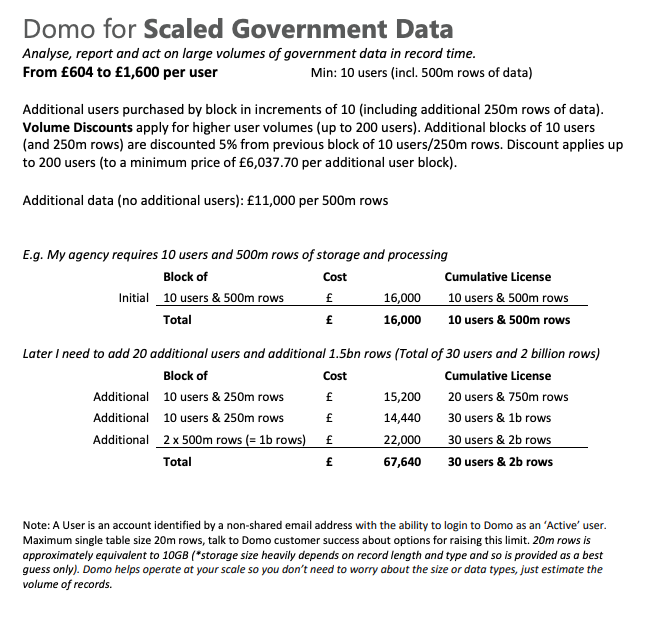 Domo's 2020 G-Cloud quote for Scaled Government Data, from the seat-based era
Domo vs Power BI vs Tableau pricing
Buyers usually compare Domo against Power BI and Tableau, which both publish per-user prices:
| Domo | Power BI | Tableau | |
|---|---|---|---|
| Pricing model | Credits for data activity; unlimited users | Per user, or Fabric capacity | Per user, by role |
| Published prices | No (entry tier only via AWS Marketplace) | Yes | Yes |
| Entry price | About $30,000/year | Pro $14/user/month; Premium Per User $24/user/month | $15–$75/user/month by role |
| Data pipeline included | Yes (connectors, Magic ETL, storage) | Partly (Power Query, Dataflows, Fabric) | Partly (Tableau Prep); no bundled warehouse |
| What drives the bill | Refresh frequency, dataflows, storage, external accounts, AI | Number of authors and viewers, or capacity size | Number of Creators, Explorers and Viewers |
Domo can cost less than per-user tools for companies with hundreds of light users and a few data sources that refresh daily. It costs more for small teams with many sources, frequent refreshes or customer-facing accounts, because those drive credits regardless of headcount. Power BI and Tableau also need a separate pipeline and warehouse for many teams, so compare total cost, not license cost alone.
How to get a Domo quote you can compare
Ask Domo's sales team for the following in writing before you sign:
- The number of credits and the price per credit. These two numbers let you compare tiers and renewals.
- The Contract Rate for AI. It sets how many credits each million AI tokens costs.
- A credit forecast for your actual data model. List every source with its refresh frequency, every dataflow with its type, and the rows you will store in Domo.
- External access costs. Ask how End Customer Accounts and embedded card loads are billed if you share data outside the company.
- Overage and mid-term top-up pricing. Ask whether extra credits cost the same rate as the original pool.
- Renewal terms under Progress. Ask for a renewal price cap and confirm that the contract assigns cleanly to the new owner.
When Domo's pricing makes sense
Domo's pricing fits companies that want one vendor for connectors, ETL, storage, dashboards and apps, have many business users who mainly view content, and refresh most data daily rather than hourly. It fits less well for teams that already run a cloud warehouse and a transformation tool, for SaaS companies that need to serve hundreds of customers, and for teams that need a cost they can forecast without modeling credit consumption.
Holistics: a Domo alternative with published pricing
Holistics is an AI analytics platform that lets everyone in your organization ask questions in plain language and get reliable answers. The platform is built on a programmable semantic layer and analytics-as-code, so AI and humans reason from the same governed business logic.
Internal analytics plans start at $800/month (Entry) and $1,000/month (Standard), billed annually, each including the first 10 users, with additional users at $12.50 per user per month.
Embedded analytics uses flat tiers sized by end-user volume: $3,000, $6,000 and $12,000 per month (billed annually) for up to 5,000, 15,000 and 50,000 embedded end users, with no per-viewer fees and no query metering (embedded pricing). A free trial is available.
You can white-label and embed Holistics dashboards and AI in your product.
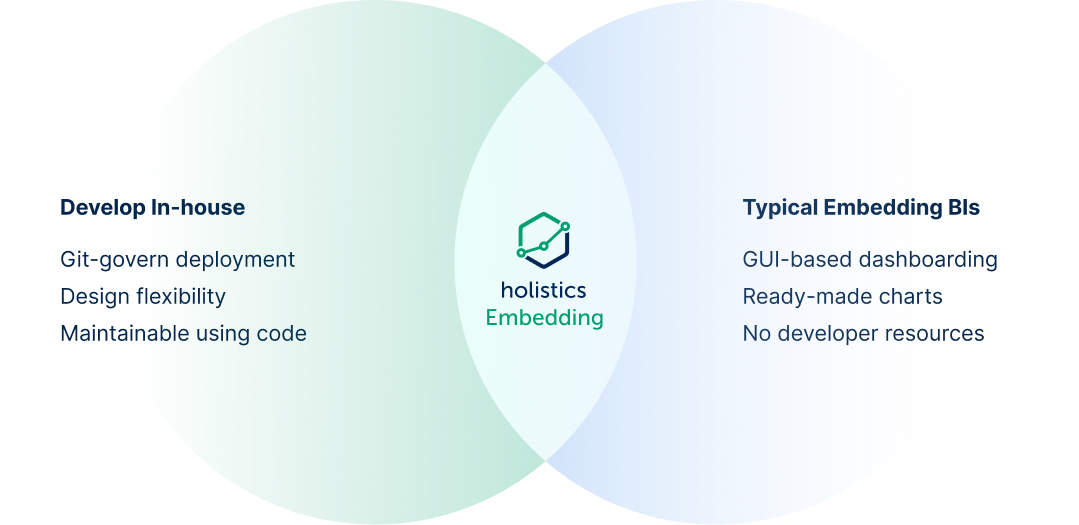
(For a feature-by-feature evaluation of embedded BI vendors, see our embedded analytics comparison.)
Frequently asked questions
How much does Domo cost per year?
Domo's entry contract costs $30,000 a year on AWS Marketplace, at $3.25 per credit.
Vendr's data on 91 purchases puts the median at $50,000 a year, with contracts ranging from about $10,900 to $175,000. Large deployments with frequent refreshes, external accounts or heavy AI usage cost more.
Does Domo charge per user?
No. Domo's consumption model includes unlimited users. Costs come from data ingestion, dataflows, storage in Domo, workflows, external customer accounts and AI usage.
Is there a free version of Domo?
No. Domo offers a 30-day free trial with full platform access and no credit card, but no permanent free tier.
How much is one Domo credit?
Domo does not publish a standard rate. Its AWS Marketplace entry tier prices credits at $3.25 each, and Domo says the price per credit drops with larger or longer commitments.
Does Domo AI cost extra?
Domo AI features are included in the contract. Domo AI Pro features, including AI chat since November 1, 2026, consume 0.01 credit per operation plus model tokens converted to credits at your Contract Rate. A customer-provided model consumes no credits for token processing.
Did the Progress acquisition change Domo's pricing?
Not yet. Progress completed the purchase of Domo's platform business on September 22, 2026, and Domo's pricing pages still describe the same credit model. Buyers should still negotiate renewal caps and contract assignment terms, because a new owner can change packaging at renewal.
What happens if I run out of Domo credits?
Domo's credit utilization reports show usage daily. If you use more than planned, you can buy more credits during the term or adjust your credit level at renewal. Ask whether mid-term credits are priced at your original rate.

Data Engineer turned Product; writes SQL for a living.