










I'd score AQL a 9 or 10. It's up there with the best tools I've used. It's really cool that we can now define metrics based on other metrics, stacking them on top of each other.
Ian
BI Engineer, DNSFilter

Use coding agents to build models, metrics, and dashboards. Locally on your computer with Claude, Codex and Cursor. Or in the browser with our Development Copilot.
Live preview
Your dashboard will build here
Revenue dashboard
LiveBuild datasets, define metrics, and generate dashboards in plain English, right in your browser. No setup required.
Create and modify datasets from a description. The Copilot auto-suggests relationships and defines metrics, dimensions, drill-downs, and underlying data.
Spin up multiple visualizations, filters, and controls and arrange them into a cohesive layout, from a single prompt.
Auto-generate descriptions for model fields, datasets, and tags from existing names, labels, and logic. Your layer stays self-explaining without the manual writeup.
Generate commit messages and pull-request descriptions from your current changes and your PR template, ready for review in one click.
Connect your favorite coding agent, Claude Code, Cursor, or Codex, to your BI codebase. Run queries, build metrics, and preview results live through Holistics' CLI and MCP tools.
A real session, a coding agent building Holistics analytics from the terminal.
git clone your repo, then run /setup-amql-development. One command wires up the CLI, MCP, and live sync.
Ask Claude Code, Cursor, or Codex. It explores your workspace over MCP and writes the AML.
Every save syncs to a cloud dev branch in seconds. See the real dashboard and tweak it back.
Commit, open a pull request for review, and merge. Or publish straight to production.
Your agent edits AML on disk. Three connections do the rest: code, MCP, and Git.
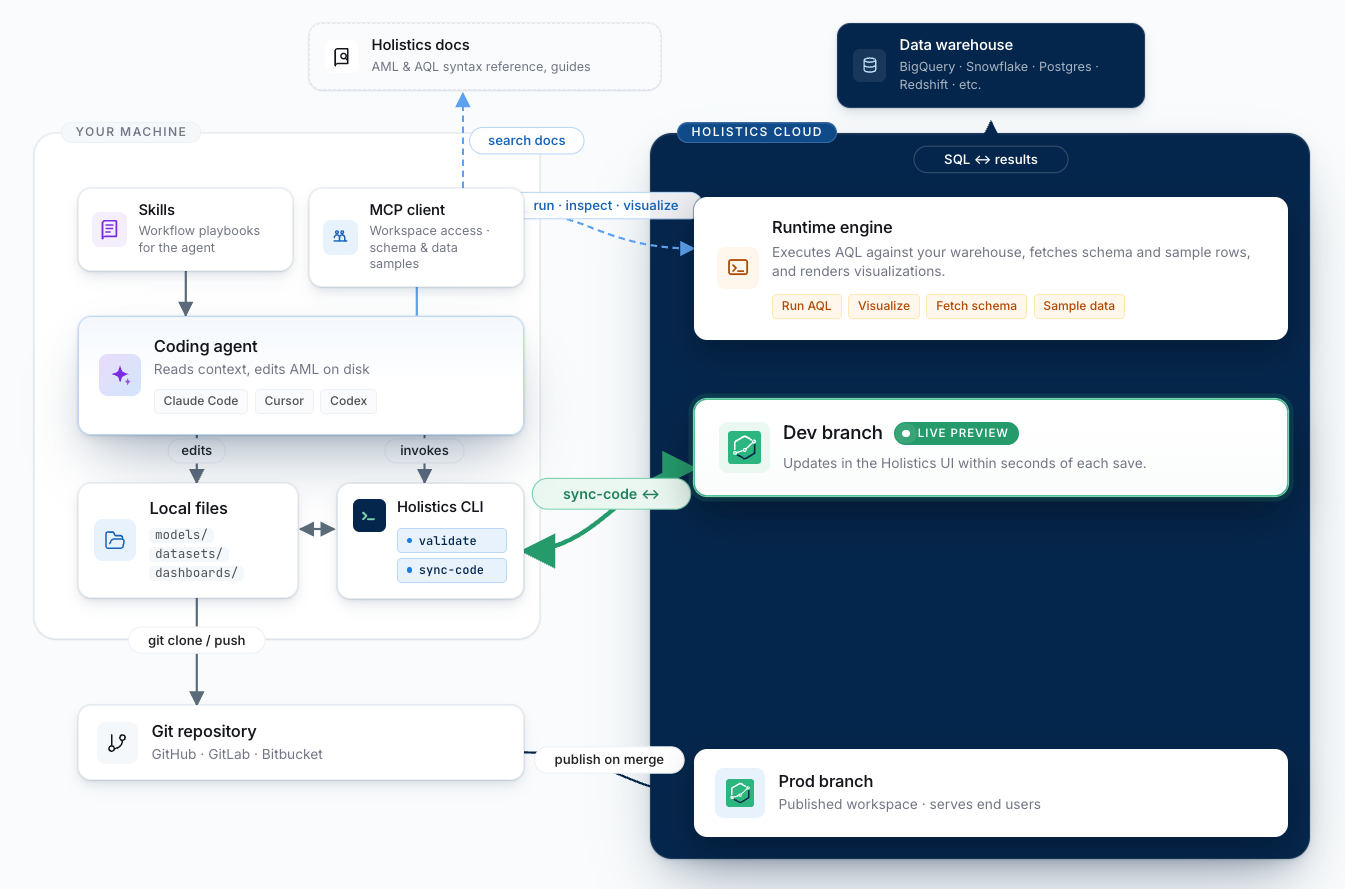
Your agent inspects schema, runs AQL, and searches the docs against your real warehouse, so it's grounded in what's actually there instead of a guess.
Every save streams to a cloud dev branch; the real dashboard renders within seconds, and edits in the UI sync back to your files.
Clone and push your BI as code. Open a pull request, validate in CI, and merge to publish the prod branch.
Agents need a substrate they can read, reason on, and change safely. Here's what Holistics gives them.
Every model, metric, and dashboard is typed AML in Git. Agents edit real code, with history, branches, and pull requests, instead of clicking through a config UI.
Agents generate AQL against your governed definitions instead of raw text-to-SQL, so the query is grounded in metrics your team already trusts and you can read what it actually did.
The MCP server gives any agent live workspace access. It can explore models, run queries, and inspect schemas, reasoning from the same definitions everywhere.
Agent-authored or hand-written, every change runs through the same guardrails.
Agents compose from endorsed metrics and relationships instead of inventing numbers from scratch.
Every change is code in Git: diffs, pull requests, and approvals before anything reaches production.
Each metric traces back to its definition and the models it's built from, so answers hold up.
I'd score AQL a 9 or 10. It's up there with the best tools I've used. It's really cool that we can now define metrics based on other metrics, stacking them on top of each other.
Ian
BI Engineer, DNSFilter
Bulk edits and refactors happen in code, not by clicking through a UI for an afternoon. It keeps a lean data team fast.
Senior data engineer
Funding Societies
Non-technical users run their own analyses now. The data team stopped being the queue.
Data team lead
Optimal Workshop
A 30-minute walkthrough with a Holistics engineer. We'll connect a sample of your warehouse and build something with an agent, live.