BI's real problem is the missing institutional-knowledge layer underneath the dashboard.
We've spent a decade betting on one idea. The layer underneath the dashboard, where business meaning and metric definitions actually live, is the part of BI that compounds. AI didn't change that. It made it the only thing that matters.
Every BI tool eventually hits the same wall, because they're all query-and-viz builders with no durable spine.
Walk into any data team in 2026 and you'll find the same three problems, regardless of which BI vendor sits in the stack. The tools keep getting prettier and slicker, but the problems underneath don't move.
Context-poor
The tool doesn't remember what your business means. Definitions of "active user," "ARR," or "churn" live in someone's head, a Notion page, or a six-month-old Slack thread. The system never sees them, so every new question rebuilds the context from scratch.
Expertise-dependent
The quality of an answer depends on who happened to write the SQL. Two analysts produce two different numbers for the same metric. The data team becomes a human reconciliation layer, and self-service is self-service only for the people who can already write SQL.
UI-mismatched
Most BI tools force the same static dashboard on every job. But an executive, an operator, an analyst, and a data engineer each need a different way to explore and act on the same numbers. One fixed layout serves none of them well. The interface is just the artifact. The meaning lives somewhere else.
We've been building the semantic layer since 2018. Long enough to know exactly where it shines and where it breaks.
When most BI tools went all-in on drag-and-drop dashboards, we kept the modeling layer at the center of Holistics. When the "modern data stack" tried to extract metrics into a standalone product, we argued the metrics layer is inseparable from the BI workflow that consumes it. When everyone discovered AI and started shipping text-to-SQL chat, we kept building the layer that makes AI answers verifiable.
We didn't pivot. We compounded.
That conviction came from watching customers grow. We saw fast-growing companies build hundreds of dashboards, then drown in them. Metric definitions diverged. Access rules became impossible to reason about. Data teams were pulled back into repetitive support work. The real challenge has always been making analytics easier to govern, evolve, and trust over time. Creation was never the bottleneck.
So we built for that. Code-based modeling when GUIs were fashionable. Composable metrics when most tools shipped one-off SQL macros. A typed, programmable semantic layer when "semantic layer" still meant schemaless YAML configs with Jinja workarounds. None of these were popular bets at the time. They are now.
Each chapter has been the same problem, understood more deeply.
Holistics has shipped five product generations since 2015. The product has changed shape as we've learned more about how data teams actually work. The problem underneath hasn't. We've spent a decade building durable self-service analytics for the people responsible for the numbers.
A BI tool built around the modern cloud warehouse, using warehouse compute instead of in-memory extracts. The first commercial bet.
The bet · architecture over UIShaped by some of Asia's largest internet companies, which pushed us hard on access control and team-scale governance. Matured us as an enterprise product.
The bet · governance as primitiveOne of the few serious semantic-layer approaches in the market, alongside Looker. Proved the value of centralizing business logic.
The bet · meaning over queriesRe-architected from the ground up. Models, metrics, and dashboards as code, all reviewable, versioned, and governed through software workflows.
The bet · durability over polishThe semantic layer beneath the AI: composable metrics, deterministic SQL, embedded analytical expertise, adaptive user experience.
The bet · context over technologyMost of the BI tools we competed with in 2015 are no longer independent companies. We are, still self-funded and still led by the same founders a decade on.
AI has made the semantic layer the only thing that matters.
Every BI vendor now demos the same AI chat. The real differentiator is the semantic layer underneath, and most are more primitive than they look. Without a real semantic layer, AI falls back to raw text-to-SQL: confident-sounding answers, ungoverned, with no audit trail.
Holistics 5.0, which we call Semantic Intelligence BI, is the next chapter of the same bet. Beyond storing semantics in code, we're building a platform that understands the business behind the data, embeds the expertise of senior analysts and engineers, and adapts its interface to whoever is using it.
A decade of work on the semantic spine is the unfair advantage for what comes next. Our work for this chapter is putting intelligence on top of an architecture that was already built for it.
Deep semantic understanding
Beyond modeling data shape: capturing business meaning, intent, decisions, and analytical context as a durable, queryable asset.
Embedded expertise
The platform behaves like a top-tier data team grounded in the customer's own semantics. Analyst, engineer, and designer expertise are built in.
Contextualized experience
Interfaces that adapt to executives, operators, analysts, and data teams based on intent and context. No single UI gets forced on everyone.
The company behind the bet.
We're a small, opinionated company that has stayed focused on one problem for a long time. The facts below are the short version.
We've spent a decade making the argument in public.
We also believe the industry gets better when more people understand how data works. A lot of this writing exists to help business teams across the company get comfortable making decisions with data.
 Book · the long-form argument
 The Analytics Setup Guidebook.
A practitioner's guide to setting up modern analytics from scratch, covering modeling, metrics, governance, and team workflows. Read by tens of thousands of data engineers and analytics leads since publication. The thinking that shaped our product is in here, in full.
Read the guidebook → Thesis · the opinion piece
 Not all semantic layers are equal.
Our public argument on why most semantic layers can't actually carry the weight of self-service analytics. The difference shows up the moment you put AI on top of one.
Read the deck →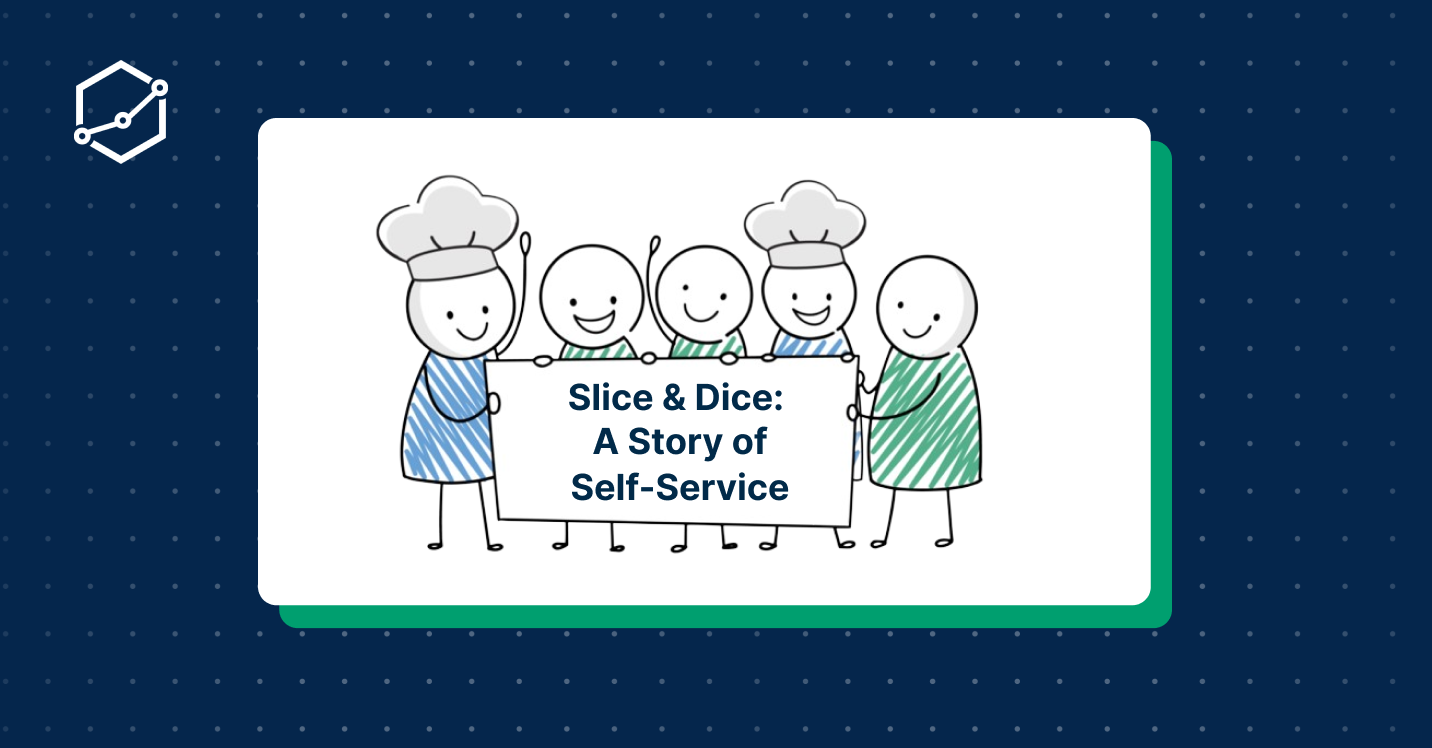 Comic · the plain-English version
 Slice n' Dice: A Self-Service Story.
We explained self-service analytics as a comic about a pizza shop, drawing out the difference between answering people's questions and teaching them to answer their own. The fastest way to prove you understand an idea is to make it this simple.
Read the comic →Other products we've built.
Along the way we built a few free tools the data community uses every day, all powered by DBML, an open-source markup language we created. They serve a different audience than Holistics, so we keep them in their own corner. They're a useful signal of how long we've worked on data tooling.



Want to see the bet in product form?
The fastest way to understand Holistics is to see the semantic layer doing work.