Agentic BI vs Traditional BI: What Changes and What Stays
A structured comparison of traditional BI, AI-assisted BI, and agentic BI. Covers the semantic ceiling, semantic leakage, and the copilot limit.
My first car was a 1997 Honda Civic with a cassette deck. When I got an iPhone, I bought a $12 cassette adapter: a little device you plugged into the headphone jack, slotted into the deck, and suddenly the old stereo was playing Spotify. It worked. Mostly. The audio was tinny. The volume was unpredictable. The adapter would eject itself at highway speeds. But it was convenient, and I told myself I had a modern sound system.
I had a cassette deck pretending to be a modern sound system.
That is what most "AI-powered BI" products are today. The dashboard is the cassette deck. The AI is the adapter. The analyst is the person pushing the tape back in every time it ejects on the highway.
A chatbot on a dashboard is the same dashboard with a faster way to ask for it. Understanding what actually changes when BI goes agentic, and what stays, requires distinguishing three eras. The gap between "AI-assisted BI" and "agentic BI" is where most confusion lives, and it is where the real product decisions are.
Three eras of business intelligence
| Dimension | Traditional BI (1990s-2020) | AI-Assisted BI (2023-present) | Agentic BI (emerging) |
|---|---|---|---|
| Who drives analysis | Human analyst or business user | Human user, assisted by AI | AI agent, reviewed by human |
| Primary artifact | Dashboard, report | Dashboard with AI summaries and suggestions | Decision workspace: evidence, reasoning, uncertainty, actions |
| How questions are answered | Navigate reports, select filters, drill down | Ask in natural language, get a chart or summary | Agent investigates: decomposes, queries, evaluates, explains |
| Follow-up questions | Start over or ask an analyst | Often resets context; limited to one-turn | Agent maintains context, deepens investigation |
| Semantic layer role | Powers field pickers and drag-and-drop | Constrains AI queries to governed metrics | Provides executable meaning for agent reasoning |
| Data team role | Report builder, dashboard factory | Same, plus manage AI configuration | Trust-infrastructure owner: governs semantic layer, evaluates agent quality |
| Business user role | Explorer, chart builder | Still the operator, but faster | Reviewer and decision-maker |
| Governance model | Access control on dashboards and data sources | Access control + prompt guardrails | Embedded: certified metrics, policies, lineage, evals, audit trail |
| Time to answer (first question) | Seconds (if dashboard exists), days (if it doesn't) | Seconds | Seconds |
| Time to answer (follow-up) | Hours to days (analyst queue) | Seconds (but shallow) | Seconds (and deep, multi-step) |
| Architecture | Report server, visualization engine, metadata layer | Same architecture + LLM integration | Semantic runtime, agent interfaces (CLI/MCP/SDK), composable query language |
| Failure mode | User builds wrong chart; nobody catches it | AI gives a plausible but wrong single-turn answer | Agent produces a wrong multi-step conclusion |
The middle column is where most of the industry is today. It is progress, but the destination is further ahead.
What is the difference between AI-assisted BI and agentic BI?
AI-assisted BI adds a natural language interface to the existing product. The user asks a question. The AI translates it into a query against the tool's existing data model. The user gets a chart or table. The fundamental product, a dashboard-era visualization tool, remains the same.
Agentic BI changes the fundamental product. The AI performs the analytical work itself, through a governed semantic layer, and presents findings for the user to review.
| Dimension | AI-Assisted BI | Agentic BI |
|---|---|---|
| AI's job | Translate user question into the tool's query format | Plan, investigate, evaluate, explain |
| User's job | Operate the tool, interpret results | Define the business question, review findings, decide |
| Depth of analysis | Single-turn: one question, one answer | Multi-step: decompose, investigate, synthesize |
| Semantic requirement | Basic: metric and dimension catalog | Deep: composable operations, valid comparisons, caveats, policies |
| What happens when AI is removed | Tool still works, it's a dashboard product | Product fundamentally changes, the agent is the primary interface |
| Interface | Chat box inside existing BI UI | CLI, MCP server, SDK: any agent can connect |
| Counter-positioning | Easy for incumbents to add | Hard for incumbents to adopt fully |
The practical test: disconnect the AI from the product. If you still have a working dashboard tool, it was AI-assisted BI. If the product cannot function without the AI, it was designed as agentic BI.
What stays the same?
Agentic BI preserves and strengthens several things from the dashboard era.
Dashboards survive. Persistent visual monitoring, executive reporting, and shared operational views still need dashboards. What changes is that dashboards stop being the center of BI. They become one evidence artifact among many, useful for specific purposes but no longer the default container for all analytical work.
Governance gets more important. When a human builds a wrong dashboard, the blast radius is the people who look at that dashboard. When an agent produces a wrong analytical conclusion, the blast radius is every decision informed by that conclusion. Governance (metric certification, row-level security, lineage, evals) moves from "nice to have" to structural requirement.
Data teams matter more. The shift from "report builder" to "trust-infrastructure owner" is a promotion. The data team's impact increases: one well-governed semantic definition serves every agent, every user, every surface. The team stops being a bottleneck and becomes the foundation.
User autonomy increases. This sounds counterintuitive. If the AI does the work, does the user lose control? The opposite: the user gains time and attention. Instead of spending 30 minutes navigating dashboards and interpreting charts to find a signal, the user spends 5 minutes reviewing an agent's investigation and deciding what to do. Autonomy means the ability to act on data, freed from the requirement to operate a tool.
What fundamentally changes?
| Old world | New world |
|---|---|
| The user should be empowered to answer their own questions | The user should be able to delegate analytical work while retaining judgment |
| The primary artifact is a dashboard | The primary artifact is a decision workspace |
| The data team builds reports | The data team governs the semantic layer |
| The semantic layer powers field pickers | The semantic layer powers agent reasoning |
| Success = dashboard adoption metrics (views, clicks, users) | Success = decision quality, time-to-insight, analytical accuracy |
| The product question: "Can users explore data?" | The product question: "Can agents answer questions users didn't know how to ask?" |
The deepest change is in the product question. Traditional BI optimized for making data explorable. Agentic BI optimizes for making analytical work delegable. Those are different objective functions that lead to different architectures.
Why does AI-assisted BI hit a ceiling?
AI-assisted BI is constrained by the semantic layer it sits on top of. And most semantic layers are more primitive than they look.
Every BI vendor demos "chat → dashboard." A look-up question on a single fact table impresses any modern LLM, on any vendor. "Show me revenue by region last quarter" works. That says almost nothing about whether the underlying system can answer the questions your business actually asks day to day.
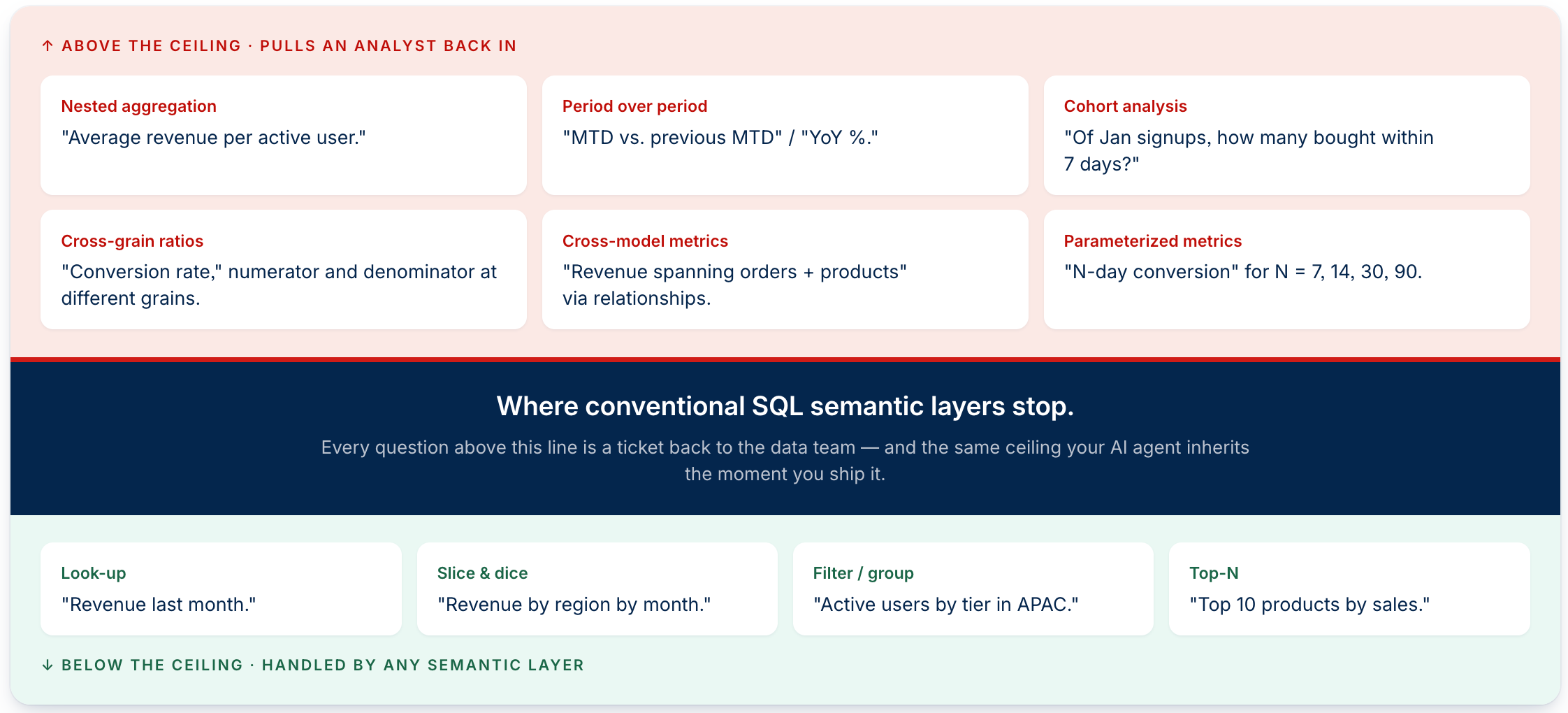
The real questions stack operators. A stakeholder asks: "Of customers who signed up in January, what was 30-day conversion vs. April's cohort, and how does ARPU compare for the two groups?" That single breath stacks four analytical operations: cohort definition, period comparison, nested aggregation, and cross-grain ratio.
Most BI semantic layers were designed for the dashboard era. They handle the simple half:
| Below the ceiling (any semantic layer) | Above the ceiling (pulls an analyst back in) |
|---|---|
| Revenue last month | Revenue growth vs. last quarter (period comparison) |
| Revenue by region by month | Average revenue per active user (nested aggregation) |
| Active users by tier in APAC | Of Jan signups, how many bought within 7 days? (cohort) |
| Top 10 products by sales | Conversion rate where numerator and denominator sit at different grains (cross-grain ratio) |
The semantic ceiling is where the system runs out of metric expressiveness. Every question above this line becomes a ticket back to the data team. And AI inherits that same ceiling the moment you ship it.
What happens when AI hits the ceiling: semantic leakage
When the semantic layer cannot answer a question natively, the AI has two options: refuse the question, or fall back to generating SQL from scratch. Most choose the second, which creates semantic leakage: business logic that should live inside the governed semantic layer escapes into raw SQL, derived tables, workbook-level calculations, or analyst memory.
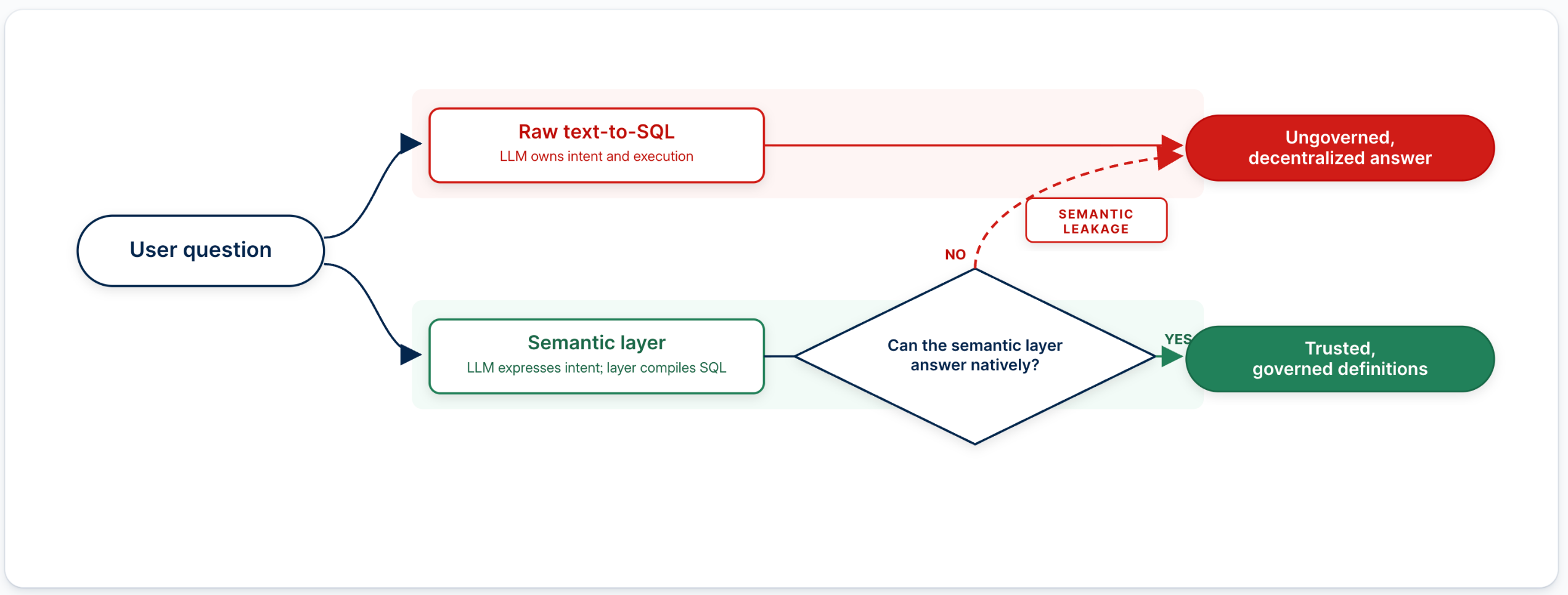
Vendors hide the leakage behind escape hatches they rebrand as features:
- Workbook-level calcs (sold as "promotable in one click"): in practice, cell-address formulas cannot be promoted. N analysts ship N variants of the same metric.
- Pre-built derived tables: one denormalized model per question shape. The warehouse fills with combinatorial table proliferation.
- Ad-hoc SQL Runner: the analyst bypasses the semantic model entirely. No lineage, no governance, drift accumulates.
Each escape hatch re-enters the exact failure mode the semantic layer was built to prevent: decentralized, ungoverned metric definitions.
Why this is worse with AI than without it
AI lowers the cost of asking questions to near zero. When a human analyst wrote ad-hoc SQL, the blast radius was one query at a time, and peer review caught most errors. When AI writes ad-hoc SQL at machine speed, volume overwhelms every verification gate: peer review, metric ownership, lineage. Errors ship and stay shipped.
The architecture may still be marketed as "AI over semantic layer." In practice it delivers conditional governance: governed when simple, probabilistic when hard. That is the copilot ceiling. The AI is only as capable as the semantic layer is expressive. Shallow semantics = shallow AI.
What does agentic BI require?
Four architectural prerequisites separate real agentic BI from relabeled copilots.
1. Code-native semantic definitions. Metrics, models, and business logic defined in version-controlled code files. Code is the interface that agents can read, modify, test, and review. GUI-defined metrics are opaque to machines.
2. A deep meaning layer. One that encodes "what can be queried" and "what can be concluded": composable analytical operations, valid comparison rules, caveats, policies, and institutional context. The semantic layer must serve agents as its primary consumer.
3. Agent interfaces. CLI, MCP server, SDK: machine-readable APIs that any AI agent can connect to. Any agent, from any surface (Claude, ChatGPT, Cursor, Slack bots, custom internal agents) should be able to query governed definitions.
4. Composable analytical logic. The query language must compose complex operations without falling back to raw SQL. Period comparisons, running totals, nested aggregations, and cross-grain ratios as first-class operations.
How should data teams evaluate the shift?
Three questions cut through vendor positioning:
1. Remove the AI. What is left? If the answer is "a working dashboard tool," the product is AI-assisted BI. The AI is a feature. The architecture stayed the same.
2. Ask a three-step follow-up question. "Show revenue by region. Now compare to last year. Now show as percentage of total, for enterprise accounts only." Does the system stay in the governed layer? Or does it fall back to raw SQL by step two?
3. Can a different AI agent connect? Is the semantic layer accessible to Claude, to a Slack bot, to a notebook, to a CLI, or only to the vendor's own chat interface? Agentic analytics platforms are agent-neutral by design.
The answers to these questions reveal whether a product was built for the agentic era or is a dashboard-era tool with an AI coat of paint.

Data Engineer turned Product; writes SQL for a living.