The Best AI Agents for Data Analysis (2026)
The best AI agent for data analysis depends less on the model than on what it can reach and how governed that connection is. We rank file analysts, native warehouse agents, and the composed MCP stack by how trustworthy their answers are.
"Best AI agent for data analysis" is the wrong question if you stop at the agent. The same model that produces a brilliant analysis of an uploaded spreadsheet will hand you a confidently number the moment you point it at your live business data. What separates a useful setup from a dangerous one is rarely the model. It is often what the agent is connected to, and how governed that connection is.
We believe this reframing matters, because the old way of sorting these tools has stopped working. People used to split them into "tools that analyze a file you upload" and "tools that query your warehouse." The split was clean until you could wire a general reasoning agent like Claude to a dbt semantic layer and Snowflake over MCP and get governed, warehouse-grade answers from a model that ships with no BI features at all.
Once that became normal, the interesting axis stopped being which agent and became what the agent can reach.
In this post, we rank the AI agents for data analysis and the stacks by what they can actually be trusted to do. Most of the opinions here are mine, and some are heavily influenced by the conversations we had with data leaders and analytics teams over the last six months. (For a broader roundup, see our review of 13 AI analytics platforms.)
How people are evaluating AI agent for data analysis
The bar has moved past chat-to-chart.
Data leaders we talked to, the ones who have watched a handful of sales demos, are no longer impressed by natural-language-to-bar-chart. No one really is. Any AI agent can quickly query your data warehouse and pull some number for you, but whether the metric is actually correct is another matter. A tool that is fast and wrong is worse than no tool, because someone acts on the wrong data.
So they now test for reasoning instead. Any conventional AI tool can show the top five products by revenue, so what earns attention is the harder question - cohort logic, time intelligence, several calculations chained into one query - because the easy question is only the baseline that most agents can handle, and the real evaluation often happens on the follow-ups.
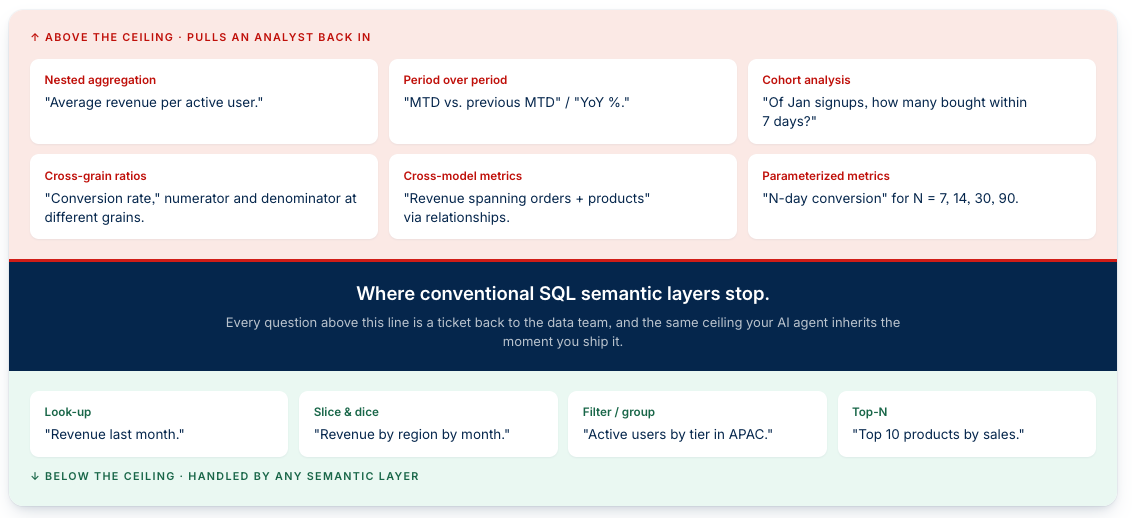 Not all semantic layers are equal
In practice, the agent is often the least differentiated part of the stack. The same model becomes far more reliable when it queries a governed semantic layer, and it starts improvising the moment you hand it raw tables. When the answers come back bad, teams tend to blame the AI, when the real cause is that there was no governed layer underneath it to reason over.
This is why a growing number of buyers would rather skip a vendor's built-in chatbot entirely. They want the governed layer exposed so their own agent can read it. The ask we hear is consistent: give us an MCP endpoint that carries the grain, the connections, and the metric logic, and we will feed it into whatever AI tools we build. (In our analysis of BI buyer conversations, about 40 deals raised bring-your-own-agent and MCP workflows.) The value they are after is the governed connection itself, rather than another conversational window.
So the useful way to evaluate a data analysis agent is to ask two questions before you ask anything about the model: what data can it reach, and what governs that reach?
How I ranked these AI Agents for Data Analysis
Six criteria, in rough order of how much they predict a trustworthy answer.
- Data it can reach. An uploaded file, a live warehouse connection, or a governed metrics layer. Each step up changes what the answer is worth.
- Trust and traceability. Does it show the query it ran, cite the metric it used, and flag ambiguity, or does it hand you a number with no way to check it?
- Governance the agent honors. Does it respect row-level permissions and metric scope? The sharpest version of this we have heard: when you attach an external agent like Claude to a BI tool, do the security and permissions from your enterprise setup still apply? If the answer is unclear, the agent is a governance gap waiting to happen.
- Depth of analysis. Can it decompose a "why did margin drop" question into steps, or does it stop at one query?
- Who it serves. Executives self-serving simple questions, or analysts who want to work in the model directly. These are different jobs, and no tool does both perfectly.
- Setup cost. Ready to use against a file, or dependent on a modeled layer you have to build first.
The best AI agents for data analysis
ChatGPT (Advanced Data Analysis)
ChatGPT is the best general-purpose file analyst available today. When you upload a CSV, it writes and runs Python to work through statistical tests, clean messy data, and reason about patterns with real skill. Its ceiling is structural and organizational, though: because it has no live company data, no semantic layer, no permissions, and no repeatability, there is no institutional learning and no single source of truth. Two people phrasing the same question can get two different answers, and nothing carries from one session to the next.
Julius AI
Julius AI is aimed squarely at analysts. It covers the full statistical stack — regression, clustering, time-series, and hypothesis testing — writing Python or R and producing clean interactive charts along the way. More recently it has grown database connectors and agents you can train on your schemas, which pushes it toward the next category. As a standalone file analyst it is excellent, but as governed company infrastructure it falls short.
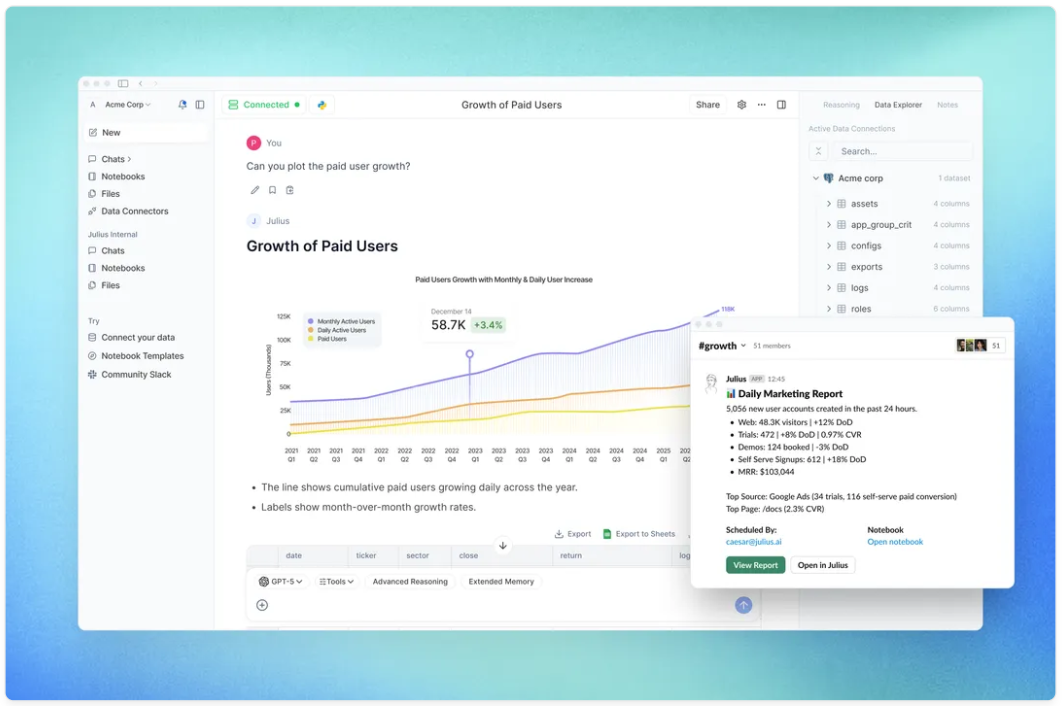 Julius AI writes Python or R and returns interactive charts from an uploaded dataset.
Claude (or any agent) + a semantic layer + your warehouse, over MCP
This is the pattern data leaders we spoke to keep asking for: you connect a general reasoning agent - Claude, or another model - to a governed semantic layer and your warehouse over MCP. The agent gets the warehouse for compute and the semantic layer for meaning, and you keep the freedom to swap the model.
In practice this looks like Claude Desktop connected to a Looker, dbt, Cube, Snowflake, or Holistics MCP server. PayPal ran this pattern for over 3,000 users through Claude Desktop and a Looker MCP server. The strength is ownership: you define the governed layer once and any agent reads it. The limit is that you assemble and maintain the stack, and the depth of what the agent can answer is capped by the semantic layer's expressiveness. A rigid layer means the agent still fails on the third follow-up and drops back to raw SQL.
Gartner's February 2026 guidance also sharpened the warning: it projected that by 2028, 60% of agentic analytics projects relying solely on MCP will fail for lack of a consistent semantic layer. MCP provides the connection, but the layer behind it decides whether the answers are right.
(For how to evaluate these agent-native setups, see our guide to agentic analytics platforms.)
Snowflake Cortex Analyst
Snowflake Cortex Analyst answers natural-language questions against semantic models and views inside Snowflake, and its managed MCP server exposes those views to external agents like Claude. It is native, well-integrated, and reliable within its walls, but the tradeoff is that your governed surface lives entirely inside Snowflake.
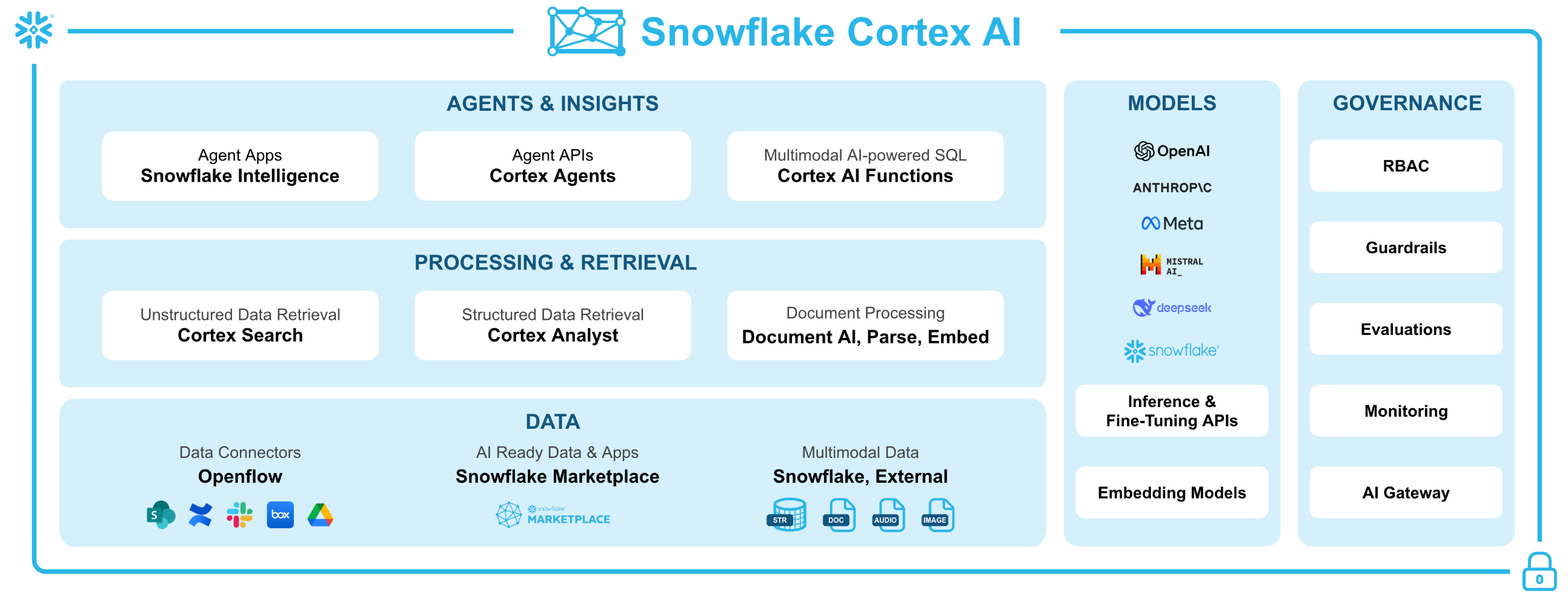 Snowflake Cortex Analyst answers natural-language questions against governed semantic views inside the warehouse.
Databricks Genie
Databricks Genie is the lakehouse equivalent, and its agentic mode now leans on Unity Catalog metric views rather than inventing local metrics. It is strong if Databricks is your primary platform, though it carries the same lock-in you have to weigh everywhere else on this list.
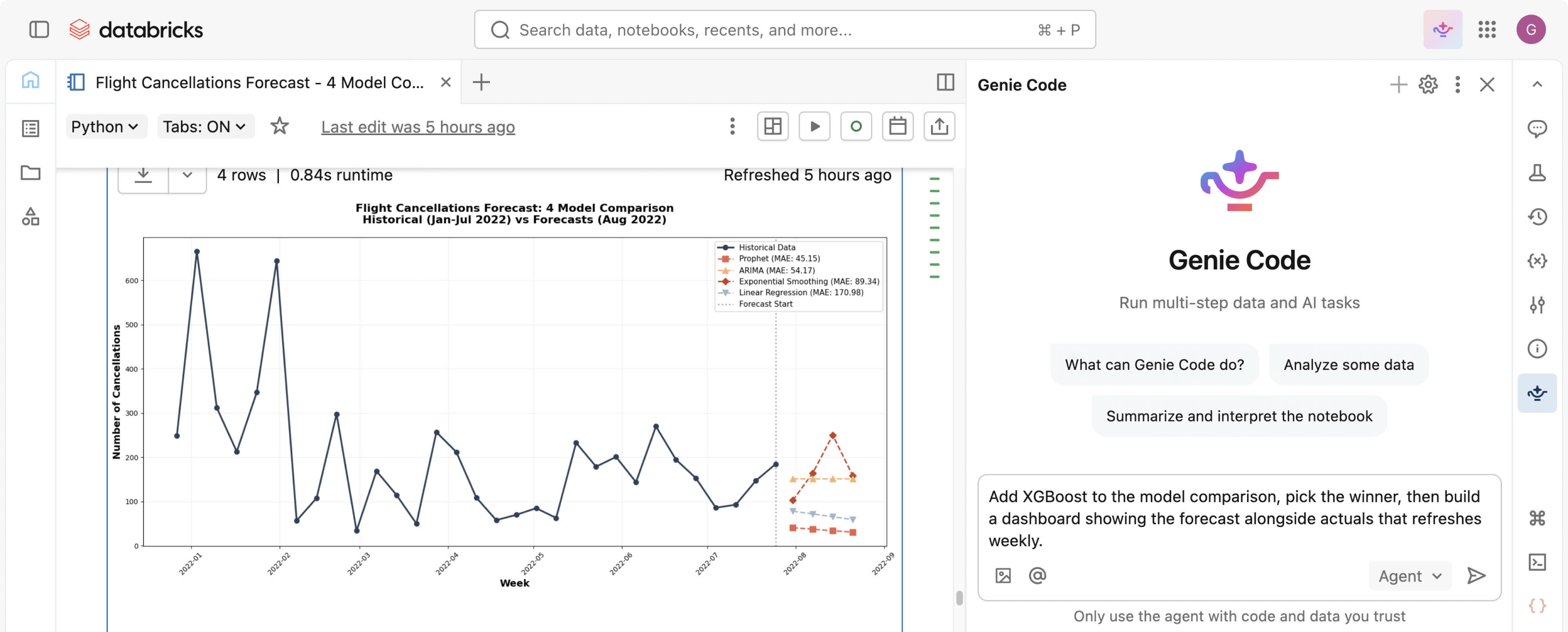 Databricks Genie answers questions against Unity Catalog metric views inside the lakehouse.
ThoughtSpot (Spotter)
ThoughtSpot is search-first analytics that, as of 2026, runs on Spotter Semantics — an agentic semantic layer — paired with a Spotter agent that leans on deterministic search tokens rather than pure text-to-SQL. It handles natural-language questions well across a large user base. The counterpoint worth testing is that some teams have left ThoughtSpot when its semantic layer proved too generic to bend to the definitions their business actually needed, so what you really want to probe is the expressiveness and flexibility of the underlying model.
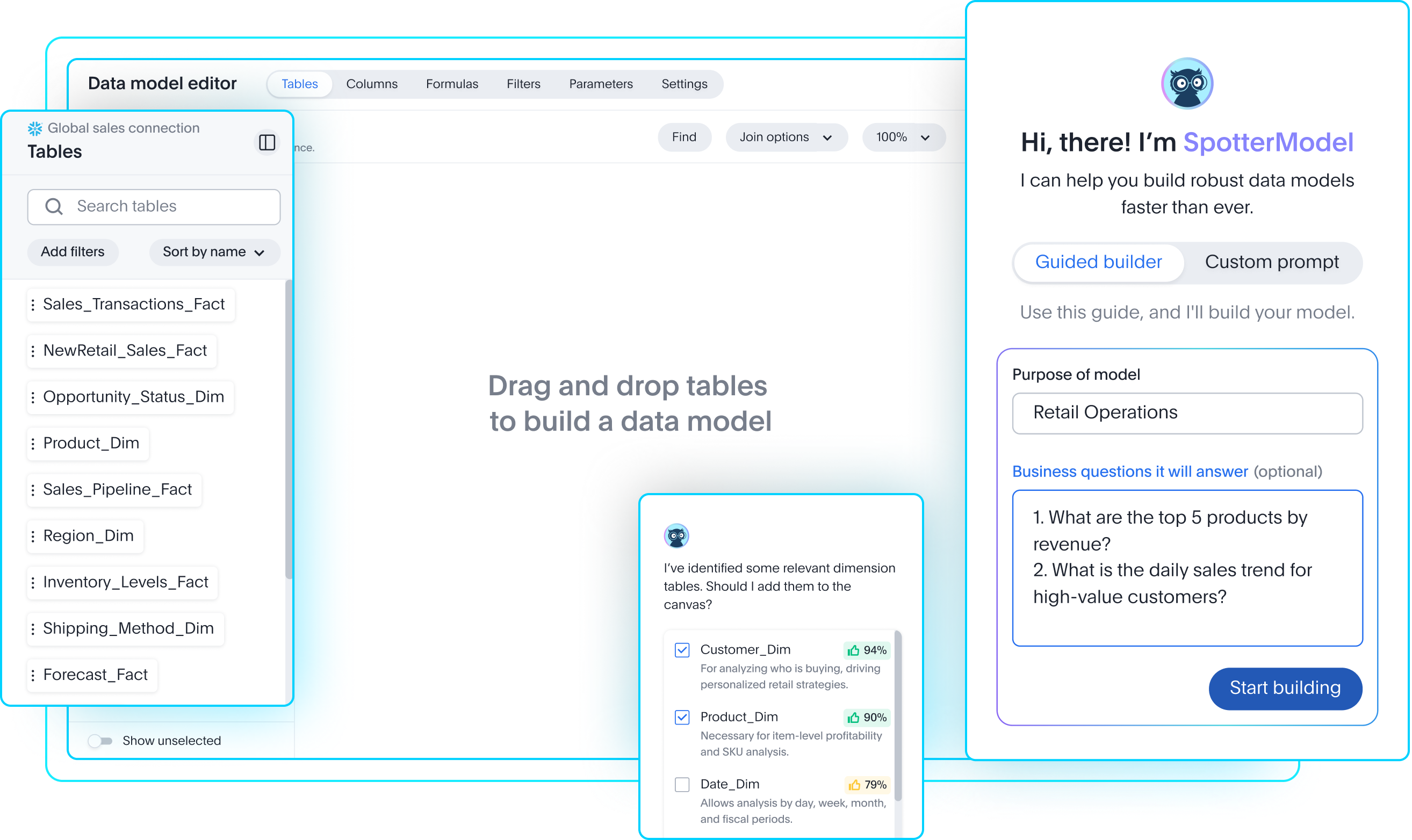 ThoughtSpot's Spotter agent resolves search-token questions over its semantic layer.
Power BI Copilot and Tableau (Agent / Pulse)
These are the incumbents' agents, embedded in the tools your business may already run. Power BI Copilot builds reports and writes DAX, but Microsoft's own guidance is candid that its usefulness is "tethered to the quality of your semantic model," and it guesses wrong on ambiguously named columns. Tableau's Einstein-powered Agent and Pulse push proactive, plain-English metric summaries into Slack and email. Both are tied to their platform's model, and both are where a lot of the hallucination complaints came from, so if your team is already committed to the ecosystem, judge them on depth rather than on the demo.
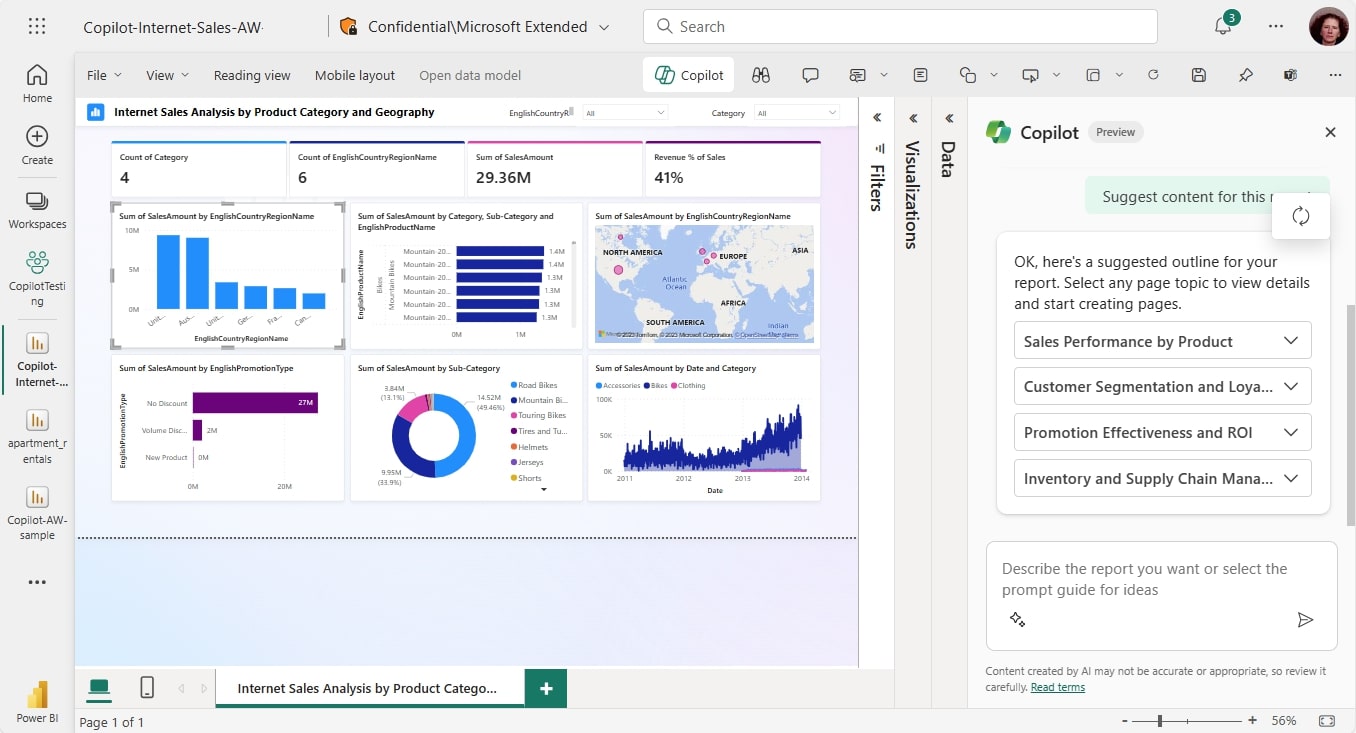 Power BI Copilot builds visuals and DAX from a natural-language prompt.
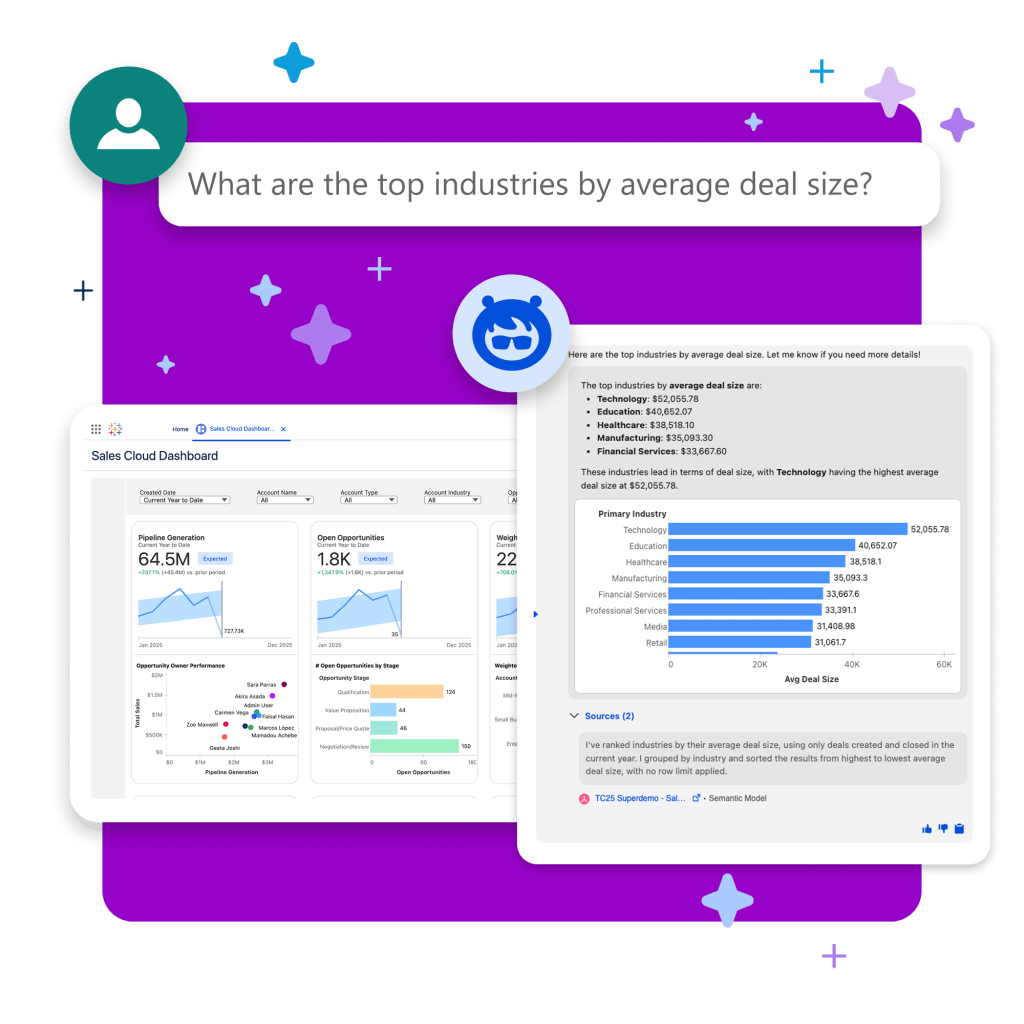 Tableau's Einstein-powered AI surfaces plain-English metric explanations.
Holistics
Holistics ships a native AI agent that works directly on top of its governed semantic layer. You talk to it in plain language to explore data, build reports and dashboards, and make sense of charts you already have, and it lives in both the reporting and development environments rather than in a bolted-on chat window. Instead of generating SQL against raw schema, it translates each question into AQL, a composable query language with first-class metrics, so period comparisons, cohort analysis, and cross-grain ratios stay proper operations rather than improvised joins.
The Holistics AI agent explores data in plain language, working directly on the governed semantic layer.
What makes it more reliable is that it reasons over your organization's AML and AQL definitions rather than inventing its own.
It reuses the metrics your business has already agreed on, inherits row-level permissions and access policies, and produces human-readable AQL you can actually verify instead of opaque SQL. What makes it more capable is that the same layer is agent-neutral: Holistics exposes an MCP server and CLI, so Claude, Cursor, Codex, or an internal agent can connect to the exact governed layer your team uses. Because natural language compiles to AQL and AQL compiles deterministically to SQL, the agent keeps reasoning inside governed definitions through the follow-up questions where rigid layers break, which is what makes Holistics both an embedded analyst and a backend for the composed-stack pattern above.
AQL lets the agent reason at a high level; the semantic layer compiles it to SQL deterministically.
The agent also reads the analytics you already have, not just the ones it builds. Point it at a chart or dashboard and it explains what the visualization shows in plain language — the trend, what moved, and what is worth a closer look — so a business user gets the takeaway without having to interpret the chart themselves. Because that explanation is grounded in the same governed metrics, the narrative describes the numbers as the business defines them rather than a guess at what the chart might mean.
The agent reads an existing chart and explains, in plain language, what it shows and why it moved.
Comparison at a glance
| Agent / stack | Data it reaches | Governance | Traceability | Who it serves | Best for |
|---|---|---|---|---|---|
| ChatGPT (ADA) | Uploaded files | None | Shows code | Individuals | One-off exploration |
| Julius AI | Files, some DB connectors | Minimal | Shows code | Analysts | Statistical analysis on files |
| Claude (standalone) | Files, pasted data | None | Shows reasoning | Individuals | Ad hoc reasoning |
| Agent + semantic layer + warehouse (MCP) | Governed metrics + warehouse | Inherited from layer | Depends on layer | Analysts + builders | Bring-your-own-agent on governed data |
| Snowflake Cortex Analyst | Snowflake semantic views | In-warehouse | Shows SQL | Business + analysts | Snowflake-committed teams |
| Databricks Genie | Unity Catalog metrics | In-catalog | Shows SQL | Business + analysts | Databricks-native teams |
| ThoughtSpot Spotter | Spotter Semantics layer | Yes | Search tokens | Business users | Search-first NL for many users |
| Power BI / Tableau AI | Platform semantic model | Platform-bound | Partial | Business users | Existing MS / Salesforce shops |
| Holistics | Governed AML/AQL layer + warehouse | Inherited, code-defined | Shows query + metric | Analysts + business + agents | Trusted analyst on modeled data, agent-neutral |
How to choose
- You need a one-off analysis of a file. ChatGPT Advanced Data Analysis, Julius, or Claude will handle it. They are fast, capable, and require nothing, but verify their output before you promote it to a company number.
- You want trusted answers on live company data, and you want to bring your own agent. The composed stack fits here: an agent wired to a semantic layer and your warehouse over MCP. The layer is the choice that matters – weight it for expressiveness and portability if you want to stay flexible (Holistics, Cube, Malloy), or accept native lock-in for tighter integration (Cortex, Genie).
- You want an embedded analyst on modeled data, with the option to feed your own agents too. A code-based, agent-neutral layer like Holistics covers both, because the same governed definitions serve the built-in experience and any external agent.

Data Engineer turned Product; writes SQL for a living.