ThoughtSpot Alternatives in 2026: 10 Tools Compared on AI, Pricing and Semantic Modeling
A practitioner comparison of 10 ThoughtSpot alternatives (Holistics, Power BI, Tableau, Looker, Sigma, Omni, Qlik, Metabase, Hex, Domo) with 2026 pricing, AI capabilities, a comparison table and a migration plan.
ThoughtSpot is an AI analytics platform built around search and, since 2024, a conversational agent called Spotter. The right alternative depends on why you are leaving: teams that want trustworthy AI answers with less upfront modeling work tend to shortlist Holistics, Looker or Omni; teams on Microsoft licensing move to Power BI; teams that care most about visual polish move to Tableau; spreadsheet-minded analysts move to Sigma; and small teams that need something free start with Metabase. If ThoughtSpot's search experience is the reason you bought it and the bill is the problem, the honest first step is to renegotiate before migrating, because few tools match ThoughtSpot's end-user search without extra configuration.
Last reviewed October 2026. Holistics makes one of the tools in this list; see "How we evaluated" at the end for our method and disclosure.
Are people still using Thoughtspot in 2026?
ThoughtSpot has repositioned itself from "search analytics" to an agentic analytics platform over the past two years, and most of the product names a buyer meets in an evaluation today did not exist when the older comparison articles were written.
Spotter, the conversational agent, launched in November 2024 and is the main interface ThoughtSpot sells; around it sit SpotterModel (which proposes tables, joins and columns for a data model, in early access), SpotterViz (which builds Liveboards from a prompt, also in early access) and SpotterCode (an assistant for developers that plugs into Cursor or VS Code through an MCP server). ThoughtSpot also exposes an MCP server so that outside agents and LLM applications can call Spotter's skills directly.
 A ThoughtSpot Liveboard (formerly a Pinboard), with the natural-language search bar at the top.
Spotter, ThoughtSpot's AI analyst, walking through a conversational analysis (video: ThoughtSpot).
A few naming changes matter if you are reading older documentation or reviews: Pinboards are now Liveboards, Worksheets are now Models, and the embedded product formerly marketed as ThoughtSpot Everywhere is now ThoughtSpot Embedded, built on the Visual Embed SDK. Analyst Studio, the SQL, Python and notebook environment for analysts, came from ThoughtSpot's 2023 acquisition of Mode Analytics. Content is serialized as TML (ThoughtSpot Modeling Language), plain-text files that can be committed to GitHub through ThoughtSpot's Git integration, which is also the main exit path if you migrate (more on that below).
ThoughtSpot is still a serious product. It was named a Leader in Gartner's 2026 Magic Quadrant for Analytics and BI Platforms, and reviewers on Gartner Peer Insights (4.5 across roughly 650 reviews) and G2 (around 4.4) consistently praise how easily business users can get an answer without learning a tool. The reasons teams leave are mostly about cost structure and what has to happen before the search experience works well, which the next two sections cover.
How much does ThoughtSpot cost?
ThoughtSpot publishes entry pricing, which puts it ahead of Domo and Sisense on transparency, though most mid-size and enterprise deals still end in a custom quote.
| Plan | Published price | Limits and inclusions |
|---|---|---|
| Essentials | From $25/user/month, billed annually | 5–50 users, up to 25M rows, interactive dashboards |
| Pro (per user) | From $50/user/month, billed annually | Up to 1,000 users, up to 250M rows, natural-language search, Spotter AI agents capped at 25 queries per user per month |
| Pro (usage-based) | From $0.10 per credit | Spotter with unlimited LLM tokens, Analyst Studio |
| Enterprise | Custom | Contact sales |
| Developer (embedded) | Free for the first year | Up to 10 users and 25M rows |
Two details affect total cost more than the list prices do. First, on the usage-based path, ThoughtSpot's consumption documentation counts credits for activities such as viewing or editing Liveboards and Answers and interacting with Spotter, so reading a dashboard is a billable event rather than a free one, and a popular dashboard costs more than an unpopular one. Second, ThoughtSpot says it does not meter or charge for LLM tokens itself, which removes one variable but leaves your warehouse compute as a separate bill with your cloud provider.
For contracts negotiated through sales, third-party procurement data is the best available guide. Vendr data cited in 2026 puts the median ThoughtSpot contract somewhere between roughly $92,500 and $100,000 a year, depending on the sample (one report covers 30 purchases with a range of about $37K to $231K; another covers 33 purchases with a range of about $39K to $222K). Vendr data cited by Colrows also suggests implementation adds 15–40% of first-year subscription value. Both figures are directional at best, since they come from buyers who used a procurement marketplace rather than from ThoughtSpot.
Why do teams look for a ThoughtSpot alternative?
The common thread behind most ThoughtSpot departures is that the product works best once a data team has done a lot of preparation, and the pricing model charges for exactly the usage that the preparation was supposed to encourage. In more detail, the five reasons that come up most often are these:
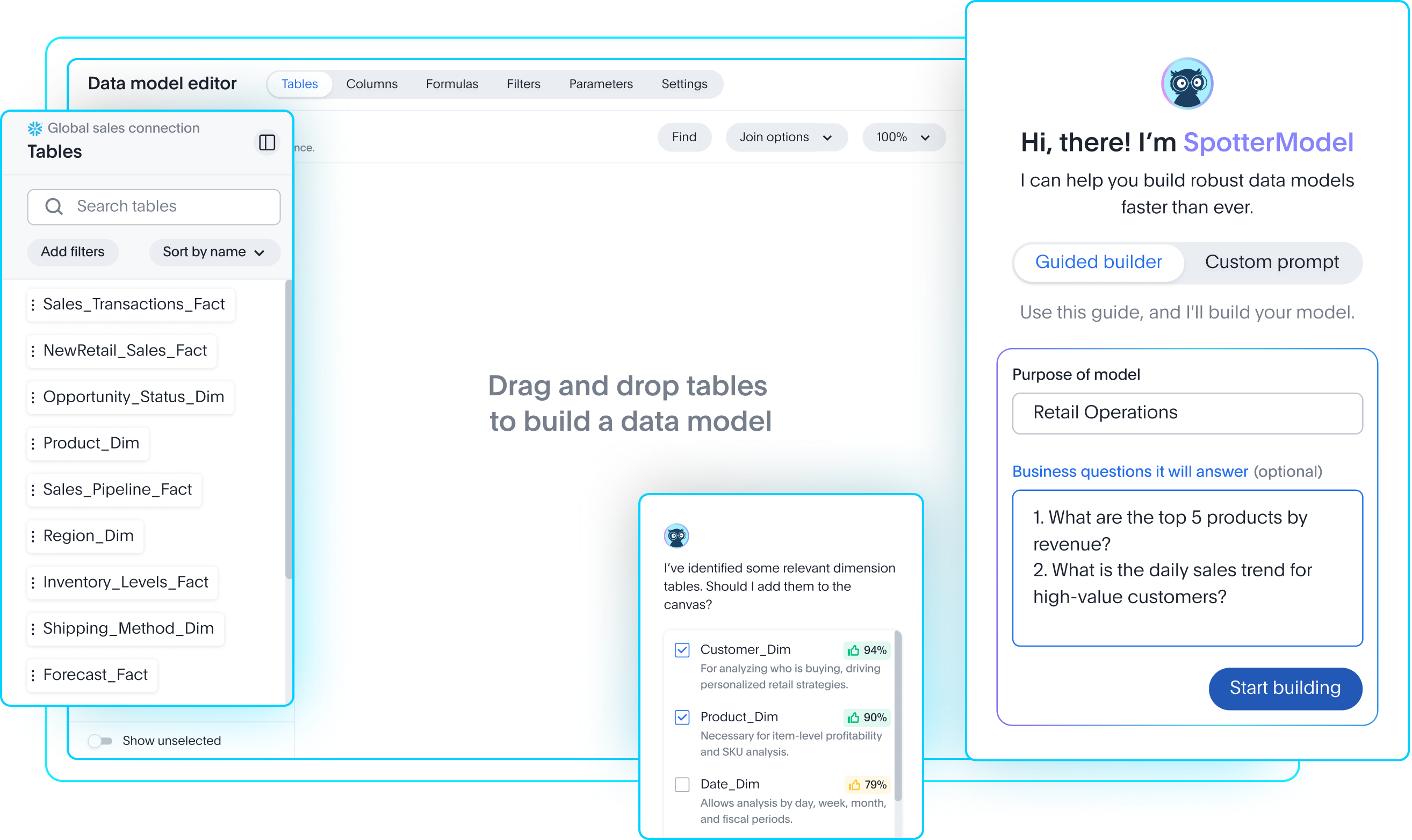 SpotterModel, ThoughtSpot's AI assistant for building data models, targets the modeling work that search accuracy depends on.
- Modeling work comes first. Natural-language search and Spotter answer well only when Models are clean, well-named and annotated with synonyms and business context. A Gartner Peer Insights reviewer put it bluntly: getting natural-language search to work was "impossible without the data team doing a huge amount of up-front data modelling work." SpotterModel is ThoughtSpot's answer to this, but it is still in early access.
- Consumption billing charges for reads. On credit-based plans, each Liveboard view and Spotter interaction consumes credits, which makes cost scale with adoption. Finance teams that wanted analytics usage to grow are then asked to budget against that growth.
- Visualization depth is limited. ThoughtSpot offers fewer chart types and less formatting control than Tableau or Power BI, and G2 reviewers often describe visuals as functional rather than presentation-ready.
- Embedded pricing is quote-only. The free Developer tier gets a prototype running, but Embedded Enterprise pricing requires a sales conversation, which makes it hard to model unit economics for a SaaS product before committing.
- Getting data out has limits. PDF exports default to 100 rows (raising the limit requires a support request), and downloads default to 1M rows with a 10M maximum, which frustrates teams that use BI as a source for spreadsheets and downstream reports.
What should a ThoughtSpot alternative offer?
Since ThoughtSpot's pitch is trustworthy self-service through AI, the most useful way to compare alternatives is to ask what makes an AI-generated answer trustworthy, and then check how each tool handles it. Feature checklists comparing "has natural-language query: yes/no" tell you little in 2026, because almost every BI tool now has one. (For a broader comparison of AI tools, see our AI analytics platforms guide.)
- A semantic modeling layer that grounds AI answers. A semantic layer is where metrics, dimensions, joins and business rules are defined once and reused everywhere, and it is also what decides whether AI answers can be trusted. An assistant that queries a governed semantic layer chooses from metrics the data team has already defined and reviewed, applies the same permissions as every dashboard, and returns numbers that match the reports people already rely on, so its answers are grounded in agreed definitions rather than in whatever the model inferred from column names. ThoughtSpot's Models (formerly Worksheets) play this role for Spotter, and the comparison that matters is expressiveness of the semantic layers: whether metrics such as running totals, percent of total, period-over-period comparisons and cohort retention can be defined once in the semantic layer, or whether each one becomes a one-off formula or a SQL workaround that the AI cannot reuse.
- Permission inheritance. AI answers should run through the same row-level and column-level permissions as everything else. This matters most in embedded analytics, where a customer-facing assistant that ignores tenant boundaries is a security incident rather than a bug.
- Inspectable output. A business user may never read the generated query, but an analyst checking a surprising number needs to see which metric, filters and joins the AI used, ideally in terms of the semantic model rather than raw SQL.
- Context you can curate. ThoughtSpot uses synonyms and coaching to steer Spotter. Alternatives should offer an equivalent way to add business context (descriptions, custom instructions, example questions) that is versioned alongside the model.
- Cost of reads. Usage-based models that charge for viewing dashboards or asking questions behave very differently from per-seat or flat pricing as adoption grows, so it is worth modeling cost at two and five times your current usage before signing.
- Version control and environments. For teams that treat analytics as software, Git workflows, pull-request review and separate development and production environments decide how safely the model can change over time.
- Embedding. If analytics ships inside your product, the evaluation should cover the embedding method (SDK, iframe, web components), tenant isolation, white-labeling and whether pricing scales with your customer count.
What are the best ThoughtSpot alternatives?
The ten tools below are ordered by how directly they replace ThoughtSpot's core use case (governed self-service with an AI layer on top), with the Microsoft, visualization-first and lower-cost options after.
1. Holistics: AI analytics grounded in a code-based semantic layer
Holistics is an AI analytics platform where business users ask questions in plain language and get answers built on governed metric definitions rather than on SQL guessed from raw tables. Holistics AI answers questions, builds explorations and summarizes dashboards by reasoning over a code-based semantic layer: models and metrics are written in AML (Analytics Modeling Language) and queried through AQL, a composable query language that handles running totals, percent of total and period-over-period comparisons as reusable metrics. Every AI query passes through the same permission controls as the rest of the product, and business users can switch to drag-and-drop exploration whenever they want to refine an answer themselves.
Holistics AI answers questions from the semantic layer, so every chart it returns uses the same metric definitions as your dashboards.
 Metrics, dimensions and relationships live in a code-based semantic layer that both people and AI query.
How Holistics compares to ThoughtSpot:
| Capability | ThoughtSpot | Holistics |
|---|---|---|
| AI interface | Spotter agent and natural-language search | Holistics AI chat grounded in the AML/AQL semantic layer |
| Modeling | Models (formerly Worksheets) built in the UI, exportable as TML | AML models and AQL metrics as code, with a visual editor |
| Complex metrics | Formulas per Model or Answer | Reusable AQL metrics (running totals, period-over-period, nested aggregations) |
| Version control | Git integration via TML (GitHub) | Native Git with branching, pull-request review and a Holistics-hosted or your own repository |
| LLM choice | ThoughtSpot-managed; no per-token charge | OpenAI with zero data retention by default, or bring your own LLM |
| Agent access | MCP server | MCP server |
| Embedded | ThoughtSpot Embedded (Visual Embed SDK), quote-only beyond the Developer tier | White-labeled embedded analytics with AI-powered self-service for end users, flat pricing by end-user volume |
Pricing: Published. Entry from $800/month and Standard from $1,000/month (billed annually), each including the first 10 users, with additional users at $12.50/user/month. Embedded analytics is priced flat by end-user volume, starting at $3,000/month (billed annually) for up to 5,000 embedded end-users, with no per-user fees or query metering on embedded users. Tiers run $3,000, $6,000 and $12,000/month for up to 5,000, 15,000 and 50,000 end users, and every tier includes full white-labeling and AI-powered self-service for your customers (a custom report builder with an AI interface, advanced drills and an embedded team workspace); see embedded pricing. Free trial available.
Best fit: Data teams that want AI answers they can trace back to governed metric definitions, analytics engineers who want the model in Git, and SaaS teams that want embedded analytics with predictable pricing.
Limitations: Holistics asks someone on the team to be comfortable with SQL and modeling as code, so teams without a data person will find the ramp steeper than ThoughtSpot's. Holistics AI is newer than Spotter and has a smaller ecosystem of agents around it, and Holistics requires an existing data warehouse or database because it does not bundle storage or an in-memory engine.
2. Microsoft Power BI: the default for Microsoft-licensed organizations
Power BI is Microsoft's BI platform, combining Power BI Desktop for authoring, the Power BI service for sharing and a DAX-based semantic model. Copilot adds natural-language report creation and Q&A, and Microsoft Fabric bundles Power BI with data engineering and warehousing capacity. (For more options, see our Power BI alternatives and Power BI Embedded guides.)
Copilot in Power BI building and explaining reports (video: Microsoft Power BI).
| Capability | ThoughtSpot | Power BI |
|---|---|---|
| AI interface | Spotter | Copilot in Power BI and Fabric |
| Modeling | Models | Semantic models with DAX measures, scoped per model |
| Visualization | Functional chart set | Broad chart library plus a custom visuals marketplace |
| Version control | Git via TML | Git integration through Fabric workspaces and PBIP project files |
| Pricing model | Per user or credits | Per user, plus Fabric capacity for Copilot |
Pricing: Power BI Pro is $14/user/month and Premium Per User is $24/user/month (both raised in April 2025). Copilot needs a paid Fabric capacity; Fabric F2 starts around $262.80/month, and F64 (which also lets free users view content) runs around $5,000/month.
Best fit: Organizations already paying for Microsoft 365 E5 or Fabric, where Power BI is effectively prepaid and Excel is the main analytical tool.
Limitations: DAX measures live inside individual semantic models, so the same metric can drift across models, and buyers report that Copilot struggles to find the right metric for the same reason. Authoring in Power BI Desktop is Windows-only, and Copilot's cost depends on capacity sizing that is hard to forecast.
3. Tableau: visualization depth with Pulse and Tableau Next
Tableau is Salesforce's analytics platform and the strongest option in this list for visual exploration and presentation-quality dashboards. Tableau Pulse delivers AI-generated metric digests, and Tableau Next is Salesforce's agentic analytics layer built on its Agentforce platform. (For more options, see our Tableau alternatives guide.)
Tableau Next, Salesforce's agentic analytics layer for Tableau (video: Tableau).
| Capability | ThoughtSpot | Tableau |
|---|---|---|
| AI interface | Spotter | Tableau Pulse; Tableau Next with Agentforce |
| Visualization | Functional | Industry-leading depth and formatting |
| Modeling | Models | Data sources and calculated fields; Tableau Semantics in Tableau Next |
| Embedding | Visual Embed SDK | Embedding API v3, Connected Apps |
Pricing: Tableau Cloud Standard is $75/user/month for Creator, $42 for Explorer and $15 for Viewer; Enterprise editions are $115, $70 and $35 respectively. Tableau Next is sold separately.
Best fit: Teams whose main complaint about ThoughtSpot is visual quality, and organizations standardized on Salesforce.
Limitations: Calculated fields are scoped to workbooks or data sources, so metric governance depends on discipline, and the most capable AI features are tied to Salesforce's Agentforce packaging. Tableau is rarely cheaper than ThoughtSpot at scale.
4. Looker: governed metrics with Gemini on Google Cloud
Looker is Google Cloud's BI platform built around LookML, a code-based modeling language that pioneered the "define the metric once" approach. Conversational Analytics, powered by Gemini, answers natural-language questions against LookML models. (For more options, see our Looker alternatives guide.)
Conversational Analytics in Looker, powered by Gemini (video: Google Cloud).
| Capability | ThoughtSpot | Looker |
|---|---|---|
| AI interface | Spotter | Conversational Analytics with Gemini |
| Modeling | Models | LookML (code-based, Git-native) |
| Version control | Git via TML | Native Git |
| Pricing | Published entry tiers | Quote-only |
Pricing: Not published. Looker Standard has been reported at $35,000–$60,000/year for a small team, enterprise contracts around $150,000/year (Vendr), and Gemini token overages are billed separately ($3 per million input tokens and $20 per million output tokens from October 2026, as reported by Colrows). (Our Looker pricing analysis covers the details.)
Best fit: Enterprises on Google Cloud with dedicated analytics engineers who will own LookML.
Limitations: LookML takes specialist time to learn and maintain, and calculations such as running totals or percent of total often need derived tables. In Holistics' buyer conversations, cost was the most frequently cited reason teams leave Looker.
5. Sigma Computing: a spreadsheet interface on the warehouse
Sigma gives business users a spreadsheet-style interface that runs directly against Snowflake, BigQuery, Databricks and other cloud warehouses, with writeback and input tables for planning workflows that ThoughtSpot does not cover.
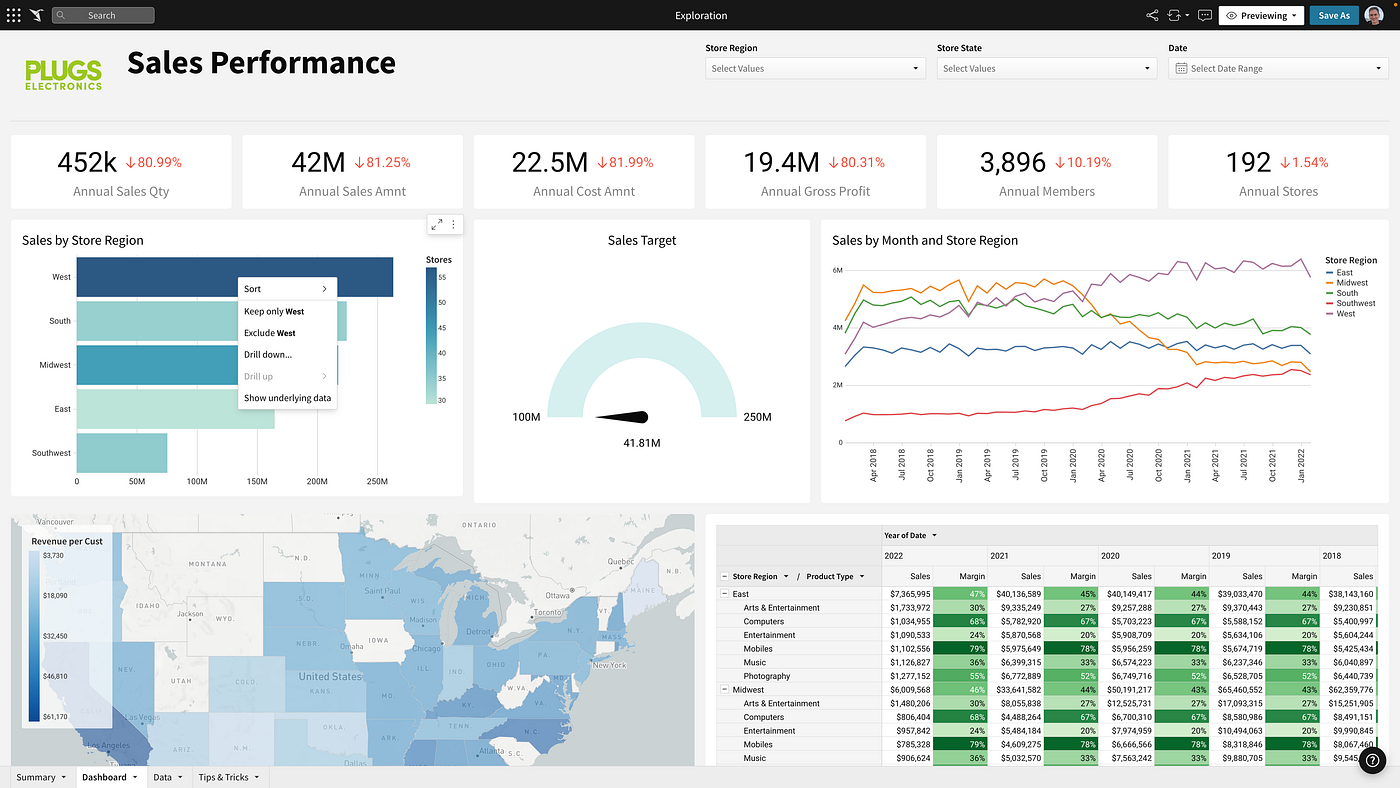 Sigma's spreadsheet-style workbook running directly on warehouse data.
| Capability | ThoughtSpot | Sigma |
|---|---|---|
| Interface | Search and Spotter | Spreadsheet-style workbooks |
| Data engine | Live query on the warehouse | Live query on the warehouse |
| Writeback | Limited | Input tables and writeback |
| Modeling | Models | Data models and workbook-level calculations |
Pricing: Quote-based. Vendr data cited in 2026 puts the median contract around $62,000/year, with a range of roughly $17,000 to $133,000.
Best fit: Finance and operations teams that think in spreadsheets and want to work on warehouse-scale data without SQL.
Limitations: Much of the logic lives in workbooks, so governance depends on how disciplined teams are with shared data models, and pricing requires a sales conversation.
6. Omni: a semantic layer that business users can extend
Omni is a BI platform from former Looker leaders that combines a shared semantic model with the freedom to write SQL or extend the model from a workbook, then promote those changes back to the shared layer. It includes an AI assistant that queries the semantic model.
Omni's product demo (video: Omni Analytics).
| Capability | ThoughtSpot | Omni |
|---|---|---|
| AI interface | Spotter | AI assistant over the semantic model |
| Modeling | Models | Shared model with workbook-level extensions, Git-backed |
| SQL access | Analyst Studio | SQL alongside the point-and-click workbook |
| Pricing | Published entry tiers | Quote-only |
Pricing: Not published. Third-party estimates put contracts around $40,000–$100,000/year, though these figures are rough.
Best fit: Teams leaving Looker or ThoughtSpot that want a governed model without forcing every change through a central team.
Limitations: Omni is younger than most tools in this list, and buyers in Holistics' conversations frequently expected it to "land pricey" before any quote and some raised concerns about AI-credit pricing.
7. Qlik Sense: associative exploration with AI add-ons
Qlik Sense is built on an associative engine that lets users explore relationships across all of their data rather than following a predefined query path, and Qlik Answers adds generative AI over structured and unstructured content. (For more options, see our Qlik alternatives guide.)
Qlik Answers, Qlik's AI assistant (video: Qlik).
| Capability | ThoughtSpot | Qlik Sense |
|---|---|---|
| Exploration model | Search and Spotter | Associative engine (green/white/gray selections) |
| Data engine | Live query | In-memory by default, with Direct Query options |
| AI | Spotter | Insight Advisor, Qlik Answers |
Pricing: Qlik Cloud Analytics Starter is $300/month, Standard $825/month and Premium $2,750/month (capacity-based, billed annually); Enterprise is custom. (Our Qlik Sense pricing guide covers the details.)
Best fit: Organizations with complex, many-source data where free-form exploration matters more than natural-language questions, and teams that already have Qlik skills.
Limitations: Qlik's scripting and data-load model has its own learning curve, and the in-memory approach means another copy of the data to manage.
8. Metabase: the low-cost, open-source option
Metabase is an open-source BI tool that is fast to deploy and easy for SQL-literate teams, with a visual query builder for everyone else and Metabot, an AI assistant, in paid tiers. (For more options, see our Metabase alternatives guide.)
Metabot, Metabase's AI data assistant (video: Metabase).
| Capability | ThoughtSpot | Metabase |
|---|---|---|
| AI interface | Spotter | Metabot |
| Modeling | Models | Models and metrics in the UI; no code-based semantic layer |
| Deployment | Cloud | Self-hosted (free) or Metabase Cloud |
| Pricing | From $25/user/month | Free self-hosted; cloud from $100/month |
Pricing: Open source is free to self-host. Metabase Cloud Starter is $100/month plus $6/user beyond the first five, Pro is $575/month plus $12/user beyond the first ten, and Enterprise starts around $20,000/year. Metabot AI is metered separately.
Best fit: Startups and small teams that need dashboards now and are ThoughtSpot customers mainly for basic reporting.
Limitations: Without a code-based semantic layer, metric definitions drift as the team grows, and AI answer quality depends on how much curation the team does in the UI.
9. Hex: notebooks and AI for analysts
Hex is a collaborative data workspace that combines SQL, Python and no-code cells in notebooks that can be published as interactive apps. Its AI features are strong for analyst workflows, and one buyer in Holistics' conversations rated Hex's AI "significantly better" than the other tools they tested.
Hex's notebook and app workflow (video: Hex).
| Capability | ThoughtSpot | Hex |
|---|---|---|
| Primary user | Business users | Analysts and data scientists |
| AI interface | Spotter | Hex Magic and AI agents in notebooks |
| Output | Liveboards | Notebooks and published data apps |
Pricing: Professional is $36/editor/month and Team is $75/editor/month; Enterprise is custom.
Best fit: Teams that bought ThoughtSpot (or Mode, now Analyst Studio) mainly for analysts doing deep, code-based analysis.
Limitations: Hex is analyst-first, so self-service for non-technical business users is weaker than ThoughtSpot's, and it is a poor fit for embedded customer-facing dashboards.
10. Domo: all-in-one, with an acquisition pending
Domo bundles connectors, ETL (Magic ETL), storage, dashboards and apps in one cloud platform. On July 22, 2026, Domo agreed to sell substantially all of its assets to Progress Software for $400 million in cash, with closing expected by the end of Progress's fiscal year on November 30, 2026, subject to approvals.
 A Domo dashboard built from cards.
| Capability | ThoughtSpot | Domo |
|---|---|---|
| Architecture | Live query on your warehouse | Data copied into Domo's own store, with federated options |
| Integration | Bring your own pipeline | 1,000+ built-in connectors and Magic ETL |
| Pricing model | Per user or credits | Consumption credits |
Pricing: Not published; Domo uses a credit-based consumption model. Vendr data cited in 2026 puts the median contract around $50,000/year (91 purchases, range roughly $11,000–$175,000).
Best fit: Organizations without a data warehouse that want one vendor for ingestion, storage and dashboards.
Limitations: Domo's roadmap under Progress is not yet public, which adds risk to a multi-year commitment signed during the transition, and logic built in Magic ETL and Beast Modes does not move easily to other tools. Our Domo alternatives guide covers this in more detail.
How do ThoughtSpot alternatives compare?
| Tool | AI interface | Semantic modeling | Version control | Pricing transparency | Starting price | Best for |
|---|---|---|---|---|---|---|
| ThoughtSpot (baseline) | Spotter agents | Models (UI, TML) | Git via TML (GitHub) | Entry tiers published | $25/user/mo | Business-user search at enterprise scale |
| Holistics | Holistics AI on semantic layer | AML/AQL (code) | Native Git | Fully published | $800/mo (10 users) | Trustworthy AI over governed metrics; embedded |
| Power BI | Copilot | DAX (per model) | Fabric Git / PBIP | Published, complex | $14/user/mo | Microsoft-licensed orgs |
| Tableau | Pulse, Tableau Next | Calculated fields; Tableau Semantics | Limited | Published | $15–$75/user/mo | Visualization-first teams |
| Looker | Gemini Conversational Analytics | LookML (code) | Native Git | Quote-only | ~$35K/yr | Google Cloud enterprises |
| Sigma | AI features in workbooks | Data models + workbook logic | Limited | Quote-only | ~$62K/yr median | Spreadsheet-minded teams |
| Omni | AI assistant | Shared model + workbook extensions | Git-backed | Quote-only | ~$40K/yr (est.) | Flexible governed modeling |
| Qlik Sense | Insight Advisor, Qlik Answers | Load scripts, associative model | Limited | Published | $300/mo | Associative exploration |
| Metabase | Metabot | UI models and metrics | No | Published | Free / $100/mo | Small teams, low budget |
| Hex | Hex Magic, agents | Semantic models (newer) | Git for projects | Published | $36/editor/mo | Analyst notebooks |
| Domo | Domo AI | Beast Modes on datasets | No | Quote-only | ~$50K/yr median | No-warehouse, all-in-one |
How to choose a ThoughtSpot alternative
The quickest way to narrow the list is to start from the reason you are leaving:
- If you need AI answers you can trust and audit, Holistics, Looker and Omni put AI on top of a governed semantic model; Holistics is the one with fully published pricing and the most expressive metric layer for calculations such as period-over-period and percent of total.
- If cost on reads is the problem, per-seat or flat pricing (Holistics, Power BI, Tableau, Metabase) behaves more predictably than credit-based billing as adoption grows.
- If your organization runs on Microsoft, Power BI is usually the cheapest move once licensing is counted, as long as you size Fabric capacity for Copilot.
- If visual quality is the main gap, Tableau leads, though it will rarely lower your bill.
- If your analysts want code and notebooks, Hex is the closest match to what Analyst Studio offers.
- If you embed analytics in a SaaS product, compare Holistics (flat pricing by end-user volume) against ThoughtSpot Embedded's quote and against embedded-first tools covered in our Sisense alternatives guide.
- If you have no data warehouse, Domo or Qlik bundle storage, though Domo's pending acquisition is worth weighing.
- If you need something free, Metabase's open-source edition is the practical starting point.
How do you migrate off ThoughtSpot?
Most ThoughtSpot migrations take one to three months for a mid-size deployment, and the work is mostly in the model rather than the dashboards. A sequence that keeps risk low looks like this:
In Holistics, every model and dashboard change goes through a branch and a review before it reaches production, which makes a parallel run easier to manage.
- Usage inventory. The admin console and system Liveboards show which Liveboards and Answers are actually viewed. In most deployments a minority of content carries most of the usage, and that minority is what gets rebuilt first; the rest is archived.
- TML export. ThoughtSpot serializes Models, Liveboards and Answers as TML, either through the UI or through the Git integration that commits TML to a GitHub branch. The export gives the migration team a complete, readable record of joins, formulas and column properties.
- Model mapping. Each ThoughtSpot Model maps to a model and dataset in the new tool's semantic layer, and each formula becomes a reusable metric. This is where an expressive metric language saves the most time, since formulas that were duplicated across Answers can collapse into one definition.
- AI context transfer. The synonyms, column descriptions and Spotter coaching your team has added are some of the most valuable assets in the deployment. They belong in the new tool's field descriptions and AI context so that natural-language answers start from the same business vocabulary.
- Parallel run. Both tools run side by side for at least one reporting cycle, with a short list of reconciliation queries comparing headline numbers until they match.
- Contract timing. ThoughtSpot contracts are typically annual, so the migration plan should finish a month or two before renewal; usage-based contracts can be wound down faster but may carry minimum commitments.
Frequently asked questions
Who are ThoughtSpot's main competitors?
ThoughtSpot's most frequent competitors in 2026 evaluations are Power BI, Tableau, Looker, Qlik Sense, Sigma with Holistics, Metabase, Hex and Domo appearing depending on the use case. For embedded analytics, ThoughtSpot Embedded also competes with Sisense, Luzmo, GoodData and Holistics.
How much does ThoughtSpot cost?
ThoughtSpot Essentials starts at $25/user/month and Pro at $50/user/month (both billed annually), with a usage-based Pro option at $0.10 per credit and custom Enterprise pricing. Negotiated contracts reported through Vendr in 2026 have a median of roughly $92,500–$100,000 a year.
Is there a free ThoughtSpot alternative?
Metabase's open-source edition is free to self-host and covers dashboards and basic self-service. Power BI has a free tier for individual use, and ThoughtSpot itself offers a free Developer tier for embedded prototypes (up to 10 users and 25M rows for one year). Most teams that need governed metrics or AI features end up on a paid plan.
What is the difference between ThoughtSpot and Power BI?
ThoughtSpot is built for business users who ask questions through search and Spotter, while Power BI is built around authored reports and DAX semantic models, with Copilot added on top. Power BI is usually cheaper for Microsoft-licensed organizations; ThoughtSpot usually wins on ease of ad-hoc questions for non-technical users.
Does ThoughtSpot support Git version control?
Yes. ThoughtSpot represents content as TML and offers Git integration through REST APIs that commit TML to a GitHub branch per Org and deploy commits back, plus UI version control for Liveboards and Answers (in early access as of release 10.9.0.cl). It is GitHub-specific and requires configuration by an admin.
Which ThoughtSpot alternative has the most trustworthy AI?
AI answer quality depends mostly on the semantic model underneath, so tools that ground AI in a governed, expressive metric layer (Holistics, Looker, Omni) tend to produce more consistent answers than tools where metrics live in individual reports. The best test is a proof of concept with your own data and twenty real questions from business users, scored for correctness and for whether an analyst can see how each answer was produced.
Is ThoughtSpot good for embedded analytics?
ThoughtSpot Embedded is a capable option with a TypeScript Visual Embed SDK, REST APIs and search embedding, and it suits products where end users need open-ended questions. Pricing beyond the free Developer tier is quote-only, which is the main reason SaaS teams compare it against flat-priced or per-tenant alternatives. For a full list of embedded analytics tools beside Thoughtspot, check out this blog post.

Data Engineer turned Product; writes SQL for a living.