The Embedded Analytics Monetization Ladder: From Dashboards to AI

Your customers want data. The question is how you package it.
Every B2B SaaS product generates data that customers care about. Usage logs, performance metrics, pipeline summaries, training outcomes. At some point, a product manager asks: should we build reporting into the product, or keep sending CSV exports?
The answer is obvious. But what comes after is where most teams get stuck. They ship a few dashboards, call it "analytics," and stop. They leave real money and retention power sitting on the shelf.
There is a better way to think about this. Treat embedded analytics as a three-tier monetization ladder, where each rung increases customer dependency, justifies a pricing premium, and raises your competitive moat.
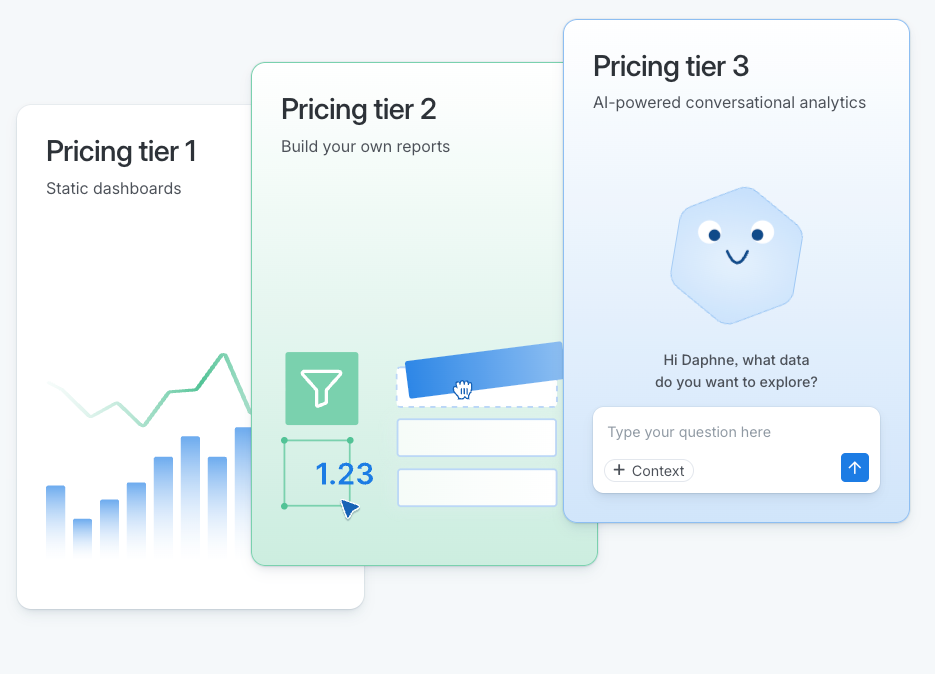
Tier 1: Static Dashboards (Standard)
This is filtered, read-only views of customer data. Pre-built charts showing KPIs relevant to each account. The customer logs in, sees their numbers, maybe filters by date range or department, and logs out.
Static dashboards are table stakes for B2B SaaS in 2026. If your product touches business operations without some form of embedded reporting, buyers notice the gap. Enterprise procurement teams have started including "native analytics" on their evaluation checklists right alongside SSO and SOC 2.
What it looks like in the product: A "Reports" or "Analytics" tab with 5-15 pre-configured dashboards. Data refreshes daily or hourly. Customers filter by common dimensions but cannot modify underlying queries or create new views.
What it costs to deliver: Relatively little. You are defining a fixed set of visualizations against your own data model. If you use an embedded analytics platform, the initial integration takes a few weeks. Ongoing maintenance is low because you control the dashboard definitions.
Pricing impact: Minimal standalone premium. Most companies include basic dashboards in their standard tier because the market expects it. The value here is defensive as it prevents churn from buyers who would leave for a competitor with better visibility.
Static dashboards create something important: the habit of logging in to check data. For example, Lepaya, a corporate training platform, found that enterprise clients like Dell and KPMG-class organizations log in 2-3 times per week specifically to view embedded dashboards. That login frequency compounds. It turns your product from a tool people use when they need to do a task into a system they check regularly.
Tier 2: Self-Service Report Creation (Professional)
This is where the economics start to get interesting.
Self-service means customers build their own reports from a governed set of metrics and dimensions. They pick what to measure, how to group it, what filters to apply. They save reports, share them with colleagues, schedule email deliveries.
The key word is "governed." You define which metrics are available and how they are calculated. Customers compose from those building blocks. They get flexibility without the risk of querying raw tables or misinterpreting joins. This is the semantic layer concept applied to embedded analytics , a curated data catalog that non-technical users can explore safely.
What it looks like in the product: An embedded report builder where customers drag metrics and dimensions onto a canvas. They choose "Average Response Time" broken down by "Region" and "Product Line," filtered to Q1. They save that view, share a link with their VP, and schedule a weekly PDF.
What it costs to deliver: More than dashboards, less than you might expect. The heavy investment is in the semantic layer, defining the metric catalog, handling permissions per customer, making sure "Revenue" means the same thing everywhere. Embedded analytics platforms handle most of the UI complexity. Your team focuses on data modeling and access control.
Pricing impact: This is where a clear tier upgrade lives. Self-service report creation supports a "Professional" or "Business" plan priced 30-50% above your standard tier. The justification is strong: customers who build their own reports extract more value from your product, and they know it.
The retention math is compelling.
Teams report a 30-40% reduction in data-related support tickets after embedding self-service analytics. Customers stop emailing your team asking for custom exports. They stop waiting three days for a report that takes them two minutes to build. That support load reduction alone can offset the cost of the embedded analytics platform.
And there is also a stickiness effect. Once a team has built 15 custom reports wired into their weekly review process, switching costs go up dramatically. Those reports encode institutional knowledge about how that company measures success. Migrating away means rebuilding all of it.
Tier 3: Conversational AI Analytics (Enterprise/Premium)
The top of the ladder. Customers ask questions in natural language and get visual answers.
"What drove the spike in churn last month?" "Compare Q4 training completion rates across our European offices." "Show me which campaigns generated the most qualified leads, broken down by source."
The system interprets the question, generates the right query against the governed metric layer, and returns a chart or table with a natural language summary. No report building. No dashboard navigation. Just questions and answers.
What it looks like in the product: A chat interface or search bar within the analytics section. The customer types a question. The system responds with a visualization and a brief explanation. Follow-up questions refine the view. The conversation history is saved and shareable.
Example of Conversational AI Analytics with Holistics Embedded
What it costs to deliver: This is the most expensive tier to build, but the cost curve is falling fast. The hard part is connecting the natural language layer to your semantic model so the AI generates correct queries against governed metrics instead of hallucinated SQL against raw tables. If your Tier 2 semantic layer is well-structured, the AI layer has a solid foundation. If you skipped Tier 2 and try to bolt conversational AI directly onto raw data, you get impressive demos and unreliable production results.
Pricing impact: Highest premium, highest differentiation. Conversational AI analytics supports an Enterprise or Premium add-on priced at 2-3x your standard tier. The buyer justification is concrete: executives and non-technical stakeholders who would never open a report builder will ask questions in a chat box. You expand the user base within each account from "the analyst who builds reports" to "everyone who has a question."
This tier is also the hardest for competitors to replicate. A static dashboard is a commodity. A report builder is a known pattern. But a conversational AI layer that reliably answers business questions requires three things working together: the data model, the AI interpretation layer, and domain-specific training data from your product's context. Replicating one is easy. Replicating all three takes years.
Read more: The Best Conversational and AI-powered Analytics Tools: Reviewed, Tested and Ranked
The Strategic Ratchet
Here is the pattern worth internalizing: each tier makes the previous tier table stakes and the next tier the differentiator.
Five years ago, static dashboards were a competitive advantage. Now they are expected. Self-service report builders used to be a feature of dedicated BI tools. Now enterprise buyers expect them inside every operational platform they purchase. Conversational AI analytics is the current differentiator, but the window is open and closing.
The companies that move up the ladder early capture compounding advantages:
- Retention: Each tier deepens how embedded your product is in the customer's workflow. Dashboards create login habits. Report builders create institutional knowledge. AI analytics creates organizational dependency.
- Pricing power: Each tier gives you a clear packaging axis. Standard includes dashboards. Professional adds self-service. Enterprise adds AI. Buyers understand the value progression because each tier maps to a broader set of users within their organization.
- Competitive moat: Each tier is harder to replicate than the last, and each tier builds on the one below it. You cannot ship reliable conversational AI analytics without a governed semantic layer. You cannot build a useful semantic layer without understanding which dashboards your customers actually need.
The ladder works because it follows your customer's own maturity curve. They start by consuming data you prepare for them. They graduate to exploring data on their own terms. Eventually, they want to ask questions and get answers without thinking about data structure at all.
Your product can either grow with that curve or get replaced by one that does.
Where to Start
If you have no embedded analytics today, start with Tier 1. Ship five dashboards covering the metrics your customers ask about most in support tickets. Measure login frequency. That baseline tells you whether users care enough about data to justify Tier 2.
If you already have dashboards, look at your support queue. Count the "can you pull this report" tickets from last quarter and multiply by the cost of each. That number is your business case for self-service.
If you have self-service and you are evaluating conversational AI, ask: how many people at each account would ask data questions but never build a report? That gap is the revenue opportunity for Tier 3.
The ladder is sequential for a reason. Each tier creates the foundation the next tier requires and the demand that makes the next tier worth building.

Data Engineer turned Product; writes SQL for a living.